I spent today rewiring my lighting system a bit--the clips seem to release a lot over the winter, so I clipped the wires and directly wired them to the 12 volt line.
Also, I noted that my entire southern face lighting burns out yearly. Some investigation shows I probably shouldn't have that in the 14 volt tap since it's close to the transformer and not much amperage. Let that be a word to the wise!
Wednesday, March 24, 2010
Lighting System Revamp

Thursday, March 18, 2010
More Photos
Temperatures are holding in the high sixties this week, so development in the grass and gardens has been exceedingly fast. Here's an image from today, post mowing it to remove the dead tips. As always, you can click on any image to embiggen it.
You can see the color's darkened considerably in just a few days, and the grass is already mostly back. Even the new seed is beginning to sprout!
The neighbors' lawns...not so much.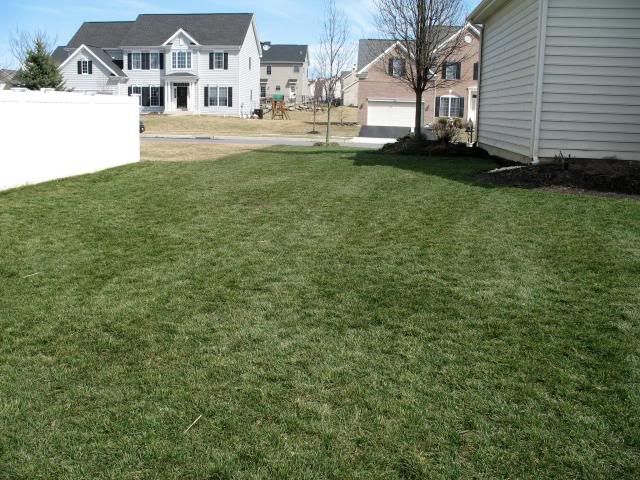
Bonus Shot #1: A blue-blooming Iris Reticulata: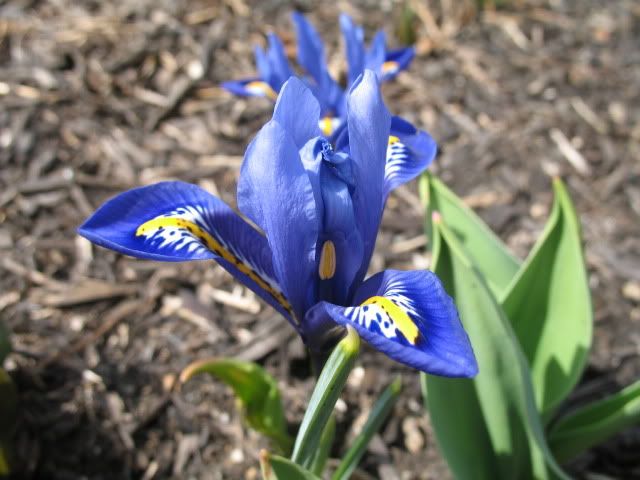
Bonus #2: Purple crocuses!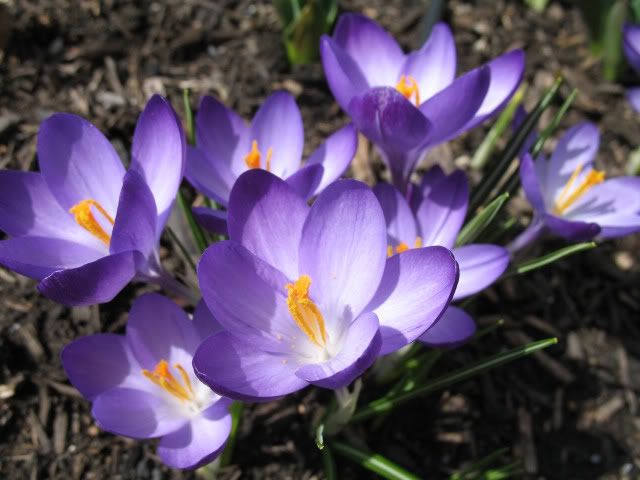
Tuesday, March 16, 2010
First Mow
I just put the Robomower out for the first mow to remove the dead tips from the grass and expose the greener mat underneath. Temperatures will be sixty or above for the rest of the week, so getting some sunlight down to the soil will help wake it up. Not that it needs much help, the green edge is already spreading out from the curb and the gardens. At this rate, by Friday the lawn will be back for the year, a month earlier than last year.
In other gardening news, I have plenty of blooming crocuses. I'll have to take a photo later.
Wednesday, March 10, 2010
Soil Samples Taken
I took my soil samples today for UMass Amherst soil testing. I'll be getting Test C, the standard soil test with organic matter. I had also gotten test E last year, soluble salts, but I don't expect that to have changed since I don't use synthetic fertilizers.
The soil difference over the last year is pretty amazing. There are very few remaining "sticky bits" of clay, and what remains crumbles pretty easily. I even disturbed a few early worms! Since half a ton of organic matter per thousand square feet went down on the lawn last year (much of that being chopped leaves), I would have expected some change. This was a bit surprising, however.
The drying soil is fairly dark, so I'm hopeful that my organic matter tests will come back with good scores this year. Last year I was at 4.6%, or tolerable but a bit low.
Saturday, March 6, 2010
Let The Games Begin!
They're beginning a month later than last year, but we had some snow this year. Additionally, the lawn probably doesn't need the organic material any longer (not after last year's addition of more than half a ton per thousand square feet). I'll take my soil samples for U. Mass Amherst shortly.
I've cleaned the gardens to fully open them up for the sprouting bulbs. The crocus should be blooming shortly, barring a sudden reverse in the weather. The back burlap line is down, and I lightly frost-seeded the entire lawn with the mix I chose for the damaged front area.
I added 90 pounds of Milorganite (12.8 pounds per thousand) today as well, for 0.64 pounds of nitrogen, 0.26 pounds of phosphorus, and 0.51 pounds of iron. That will activate over the next few weeks.
Monday, March 1, 2010
March Lawn Photo
The last blizzard is melting away nicely, and the grass is being exposed. Here's a photo, plus a bonus--the gardens are beginning to sprout. If you look closely, you'll see the earliest of the jonquils and crocuses. Here and there I have an early tulip sprouting as well.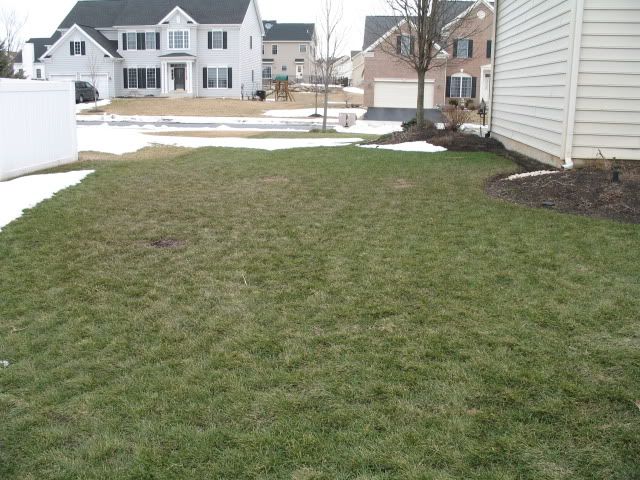

Tuesday, February 2, 2010
February Lawn Photo
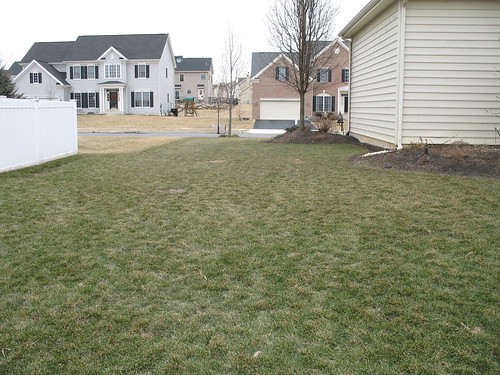
I took this one yesterday before the snow but after the extended cold period we had. The lawn is definitely in winter mode at this point and will stay there for a month or so. On the up side, this is the shortest winter period the lawn has shown (and the weather is pretty average this year), and even so, it's greener than last year at this time!
Tuesday, January 19, 2010
Winter Seeding
I winter-seeded the bad areas of the lawn (mostly the front area where the Township damaged the grass in October and November). There were a few small holes from Poa annua incursions as well.
Winter-seeding involves dropping normal levels of seed, preferably just before some winter weather (although that's not required). We're slated for some snow tomorrow into Friday, possibly. The new seed will sprout as soon as it can, usually around April 10th or so here, and it then has about 2 1/2 months to prepare for summer.
I split my winter seeding into three parts. Part one was dropped back in late November when temperatures became cold enough that the seed wouldn't sprout. Part two was today. Part three, if I can do it, will be in mid to late February. However, one winter seeding sometime during the season would be just fine, and it can be done atop the snow if necessary.
The lawn isn't looking bad for January. For the most part, it looks the same as in December, except a bit paler. Winter color this year is excellent and temperatures have been normal. First feeding isn't slated until March of this year, but that will depend on the weather.
Wednesday, December 2, 2009
December Photo
The lawn's starting to lose color for winter, which is fairly normal. It's still the greenest in the area, but I'm going to try spraying a little iron on it to put that into root storage for spring. That should accelerate spring green-up, as well as change the color a bit.
I sprayed yesterday with kelp, humates, and soil conditioner as well and that seemed to change the color to a bit darker this morning.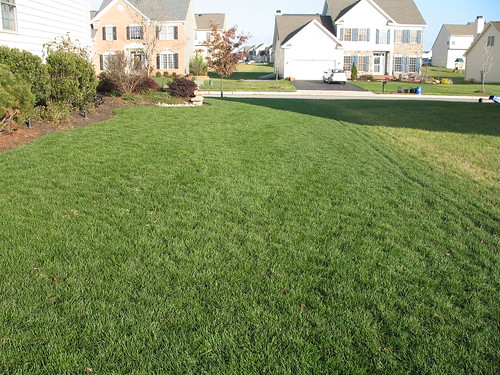
Tuesday, December 1, 2009
Kentucky Bluegrass Winter Seeding
I've done the first winter seeding (of three) of the lawn, including lightly scratching the soil and distributing seed by hand at about 1 pound per thousand.
Winter, or frost, seeding is done after soil temperatures drop under fifty (ours are actually about 48 right now, but descending fast). The seed won't germinate until spring, although normal freeze-thaw cycles will carry it into the soil fairly effectively. Unless the spring is quite dry, it doesn't need to be watered, but will require some coddling the following summer until it matures--usually the following fall.
Frost seeding isn't as effective as a fall seeding at the appropriate time (around Labor Day or a bit earlier here). However, it's more successful than a spring seeding would be, since I don't have to worry about hitting the correct window of soil temperatures. The seed will sprout the first instant it can.
I tend to divide the seedings into three--December, which is put down on scratched soil, as well as February and again in March, which are scattered as the soil is still frozen at that time. However, one seeding would be quite sufficient.
The mix I chose is a bit different this year:
Midnight II--a Compact-Midnight type. This was in my original lawn, and makes up 33% of the mix this time. This is one of the more available elite bluegrasses, and has been in continuous and heavy production for ages.
Brilliant--a Compact-America type, 20% of the mix. This is to replace the Moonlight in the original lawn which is now extremely difficult to get in sod quality from my preferred suppliers. I have no experience with this grass, but the color should be comparable.
Prosperity--A Compact type, 20% of the mix. This is to replace the Bedazzled in the original lawn, which is similarly difficult to get. I used this on the back line and it's slightly darker than Bedazzled, although not enough to notice.
Blueberry--A Compact type, 13% of th mix. I'm testing this as according to reports it's quite dark and a beautiful grass.
Moonbeam--A Compact type, 13% of the mix. This is another test grass, and again, quite dark.
To keep the darker colored grasses from being obvious, I also seeded a band around the repaired areas. The mix should blend fairly well, but if not I'll overseed with Blueberry and Moonbeam next fall across the entire lawn.
Monday, November 23, 2009
Final Fertilizer for the Lawn
I winterized the lawn today using Vigoro Super Green (35-0-5). It has a urea base, and about 1/3 of the nitrogen is slow release. As such, although temperatures are a bit high, it needs to go now. Urea needs several days to process in the soil before thinking about becoming available to the lawn, and by the time that happens our temperatures are projected to drop sharply.
Here's the entire list of items used on the lawn this year. Yes, the final total across the whole lawn is over 9,000 pounds...
| Date | N | P | K | Iron | Organics | Other Notes |
| 2/18/2009 | 0.85 | 0.43 | 0.43 | | 42.7 | Dog Food |
| 3/1/2009 | 1.03 | 0.41 | 0.31 | 0.82 | 20.6 | Milorganite, Sul-Po-Mag |
| 3/14/2009 | 0.35 | 0.14 | 0.29 | | 20.0 | Alfalfa, Sugar |
| 3/21/2009 | 1.38 | 0.54 | 0.33 | | 83.3 | Corn Meal |
| 3/28/2009 | 0.10 | 0.00 | 0.20 | | 10.0 | Kelp Meal |
| 4/4/2009 | 1.50 | 0.21 | 0.43 | | 21.4 | Soybean Meal |
| 4/18/2009 | 0.14 | 0.06 | 0.06 | | 7.8 | Dog Food, Corn Meal |
| 4/21/2009 | 1.71 | 0.61 | 0.17 | 1.97 | 30.9 | Milorganite, Ironite |
| 4/30/2009 | 0.70 | 0.24 | 0.10 | 0.93 | 12.0 | Milorganite, Ironite |
| 5/15/2009 | 1.47 | 0.48 | 0.27 | 2.16 | 24.0 | Milorganite, Ironite |
| 5/29/2009 | 0.82 | 0.23 | 0.12 | | 11.7 | Soybean Meal |
| 6/3/2009 | 0.75 | 0.30 | 0.00 | 0.71 | 15.0 | Cu, Zn, Mn, Fe, Milorganite |
| 6/10/2009 | 0.91 | 0.34 | 0.36 | 1.80 | 58.3 | Corn Meal, Kelp, FeSO4 |
| 6/25/2009 | 0.90 | 0.36 | 0.00 | 0.72 | 18.0 | Milorganite |
| 7/8/2009 | 1.73 | 0.69 | 0.20 | 1.32 | 68.0 | Corn, Milorganite, FeSO4 |
| 7/22/2009 | 1.62 | 0.52 | 0.16 | 0.42 | 26.0 | Soybean meal, Milorganite |
| 7/31/2009 | 1.41 | 0.54 | 0.34 | 0.41 | 67.4 | Corn, Milorganite, Kelp |
| 8/8/2009 | 1.86 | 0.71 | 0.23 | 0.72 | 83.0 | Corn, Milorganite, Compost |
| 8/15/2009 | 0.83 | 0.30 | 0.20 | 0.21 | 50.0 | Corn, Fe3O4, FeSO4 |
| 8/23/2009 | 1.97 | 1.36 | 0.36 | 0.41 | 62.3 | Corn, Milorganite, Starter |
| 9/1/2009 | 2.13 | 1.29 | 0.28 | 0.34 | 21.4 | Soybean Meal, Starter |
| 9/13/2009 | 2.06 | 1.27 | 0.41 | 0.25 | 21.4 | Soybean Meal, Starter |
| 9/26/2009 | 1.51 | 1.30 | 0.24 | 0.63 | 15.4 | Milorganite, Starter |
| 10/6/2009 | 0.77 | 0.31 | 0.00 | 0.62 | 15.4 | Milorganite |
| 10/14/2009 | 1.36 | 0.98 | 0.11 | 0.72 | 18.0 | Milorganite, Starter |
| 10/22/2009 | 0.77 | 0.31 | 0.00 | 0.62 | 15.4 | Milorganite |
| 10/29/2009 | 1.47 | 0.75 | 0.38 | 0.72 | 18.0 | Milorganite, Starter |
| 11/12/2009 | 0.90 | 0.36 | 0.00 | 0.72 | 18.0 | Milorganite |
| 11/17/2009 | 2.45 | 1.07 | 0.46 | 0.33 | 306.4 | Leaves 2,145 pounds |
| 11/23/2009 | 1.35 | 0.00 | 0.19 | 0.00 | 0.0 | Vigoro Super Green |
| | | | | | | |
| Total per K ft: | 36.80 | 16.11 | 6.64 | 17.55 | 1179.8 | 9087 active organic total |
Final Fertilizer for the Gardens
I put down 108 pounds of Milorganite today to increase the organic levels (54 pounds per thousand). That's the last feeding for the garden.
Here's the entire list of what's gone down this year:
| Date | N | P | K | Iron | Organics | Notes |
| 2/21/2009 | 0.90 | 0.36 | 0.00 | 0.72 | 18.0 | Milorganite |
| 3/7/2009 | 1.61 | 0.23 | 0.46 | 23.0 | Soybean Meal | |
| 3/21/2009 | 0.41 | 0.16 | 0.10 | 25.0 | Corn Meal | |
| 3/28/2009 | 0.73 | 0.25 | 0.83 | 35.0 | Alfalfa, Kelp | |
| 4/4/2009 | 1.65 | 0.23 | 0.47 | 23.5 | Soybean Meal | |
| 4/21/2009 | 1.50 | 0.60 | 0.00 | 1.20 | 30.5 | Milorganite |
| 5/30/2009 | 0.88 | 0.25 | 0.00 | 12.5 | Soybean Meal | |
| 6/25/2009 | 0.90 | 0.36 | 0.00 | 0.72 | 18.0 | Milorganite |
| 7/20/2009 | 1.40 | 0.40 | 0.20 | 20.0 | Soybean Meal | |
| 8/3/2009 | 0.90 | 0.36 | 0.00 | 0.72 | 18.0 | Milorganite |
| 9/13/2009 | 3.15 | 2.39 | 0.60 | 25.0 | Starter, Soybean Meal | |
| 10/10/2009 | 3.20 | 2.61 | 0.35 | 1.44 | 36.0 | Starter, Milorganite |
| 10/26/2009 | 1.62 | 2.16 | 1.08 | 0.00 | Starter | |
| 11/11/2009 | 3.15 | 2.52 | 0.90 | 1.44 | 36.0 | Starter, Milorganite |
| 11/23/2009 | 2.70 | 1.08 | 0.00 | 2.16 | 54.0 | Milorganite |
| Total per K ft: | 24.70 | 13.96 | 4.99 | 8.40 | 375.5 | 751 active organic total |
Monday, November 16, 2009
Still More Leaves
I've finished the lawn--with 2,000 pounds of leaves in 97 bags, or a cube 8 feet on a side (and a bit).
Any remaining stock will go to increasing the leaf mulch on the drier southern face, plus repairing the soil in the areas the Township damaged and still hasn't fixed (on day 12 and still going!)
However, any remaining stock is going to be limited. Last weekend's storm took down most of the remaining leaves, and I expect about 20 more bags before the end of leaf season.
Thursday, November 12, 2009
The Last of the Milorganite
For the season, anyway! I put down 108 pounds over 6,000 square feet (about 18 pounds per thousand), and went heavily through the Township-damaged areas. I'll follow up with photos of those when I can face them...
Normally I'd publish my entire year of organic additions, but I'll hold off until the leaves are done. I'm still importing them at a fairly high rate.
The Winterizer is yet to go, but that has to wait for soil temperatures to fall under 40. So far, that looks like it won't happen for some time yet.
More Leaves
I've applied around 1,750 pounds of leaves to the lawn and I'm close to 80% complete at this point. The first areas of application are already invisible even applying at nearly 300 pounds per thousand. After a short period, the leaf litter breaks down into black organic matter that's invisible on the soil.
My current estimate is around 2,000 pounds of leaves (a full ton!) to complete the property. That should raise organic matter about half a percent in the soil.
Subscribe to:
Posts (Atom)