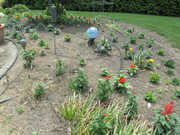
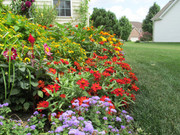
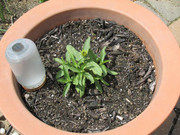
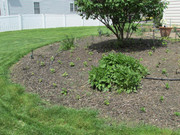
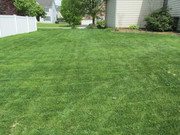
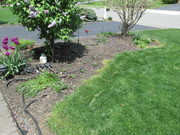
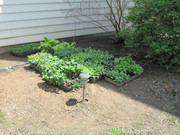
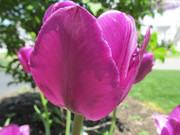
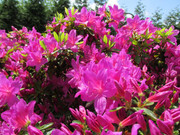
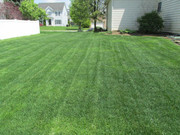
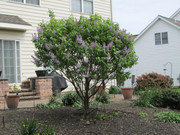
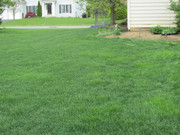
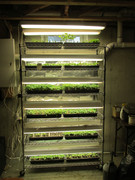
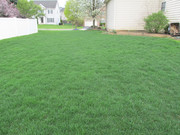
We had a near-frost event last Sunday, and a frost last Monday. The gardens took some damage, including the loss of around ten plants that were the least protected. Another twenty or so frost-burned.
I replaced the ten lost plants, but recovery on the twenty burned (but living and otherwise healthy) plants has been very slow.
When this happens to you, inspect the plant closely. If the leaves under the burned leaves are still green, there's hope. Remove the damaged leaves (the leaf is rarely damaged back to the stem on a light frost, and you can leave the green part of it if you want). It may take a day or so until all of the damage is apparent.
Water well the next morning, and don't feed just yet. Hold feedings until the weather returns to a more-normal pattern, then resume normally.
This frost was severe enough that recovery is quite slow on most of my plants. Those that were burned still look fairly badly off a week later. They should recover, but it does delay those sections of the gardens by at least a week.
Tuesday, May 21, 2013
A Very Slow Recovery
Wednesday, May 15, 2013
The First Feeding
This year, I'm performing an experiment. I didn't feed the lawn at all this spring--normal if you feed synthetically, but all my feedings are organic except the winterization one in late November.
As of a few days ago, the lawn is starting to lose a bit of color, so it was definitely time. What I put down now won't activate for about three weeks anyway, so I should see an improvement after Memorial Day.
So I trundled off to the local grain mill and bought 300 pounds of soybean meal. The target was to have half of that down today.
I missed the target by about 20 pounds, which is completely my fault. However, I'll divert that last 20 pounds to the June garden feeding.
Still, 13 pounds per thousand (130 pounds total on the lawn) gives a bit over 0.9 pounds per thousand square feet of nitrogen, more than enough for a spring feeding. The next scheduled feed won't be until August first, to take effect in late August just as the temperatures start to drop.
The gardens get fed monthly through the season with at least half a pound of organic nitrogen per thousand per month, and sometimes up to a full pound of N.
Tuesday, May 7, 2013
The Start of (Solar) Summer!
May fifth was the official start of Solar Summer, the twelve weeks of the year with the most sunlight. Solar fall officially starts on August 5th.
I actually jumped the gun on Solar Summer by a whole day and started planting my gardens the morning of the fourth. Seven hundred and fifty annuals later, I'm done (the last hundred and fifty go to my mother for her garden).
Spring isn't quite done for yet. As always, click on any image below to embiggen.
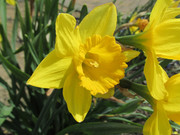
This is a double daffodil, which blooms rather late. They're usually
the last of the daffodils in the garden, and the patch isn't into full
bloom just yet. They'll finish up in about ten to twelve days or so.
I can't for the life of me remember what these are offhand. But they sure are pretty!
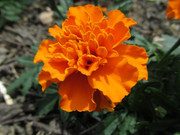
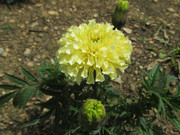
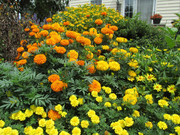
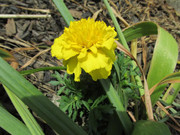
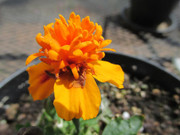
While Spring...er, springs...summer is also coming into play. The first marigolds, just transplanted a few days ago, are in bloom and should stay that way for most of the summer.
Ageratum is a garden favorite for me. Strangely, most people tell me they have some difficulty with it, whereas mine get huge and bloom constantly.
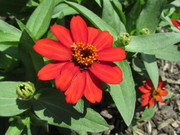
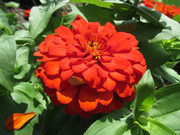
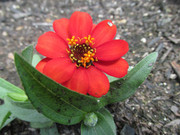
Red zinnia are another favorite. Last year's got somewhat hit by fungus, but I'm hopeful that this year will be better. This particular zinnia is a Giant Scarlet Flame, alone in a very big pot, and should stand about three feet tall at maturity.
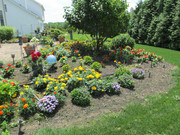
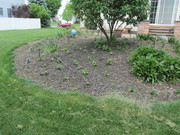
While currently unimpressive--even a little silly!--here's the photo across the back curve of the rear bed. I'm presenting this one a little larger so you can actually see the plants, but you can click to make it even larger.
Saturday, April 27, 2013
Spring's Almost Done...Almost!
Today was the day that 12 flats of annuals finally came out of the cellar and went into the most shadowed portion of the garden to begin hardening off (click to embiggen):

Throughout the next week or so, I'll move the flats outward into the sun. Right now, the most tolerant plants (marigold and zinnia, mostly) are at the front where they'll receive some late afternoon sunlight. By the end of next week, all the plants will be in the sun. Our temperatures at night through the period won't go below forty, and usually stay well above that. I'll pull them in if there's a frost projected, of course.
While that heralds the start of official garden summer, spring isn't done just yet. The tulips, those that remain, are in bloom. And you can see I seriously need mulch in this area...

Bonus photo! Our new puppy, Riley, rather enjoys the lawn. This was the lawn just after I chopped up the spring trash for the compost bin, so it's a bit of a mess. The robot is out mowing it now.

Saturday, April 20, 2013
Spring's Still Springing
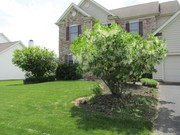
The Cleveland pear tree finally bloomed on Friday.

If you look closely at the grass, you'll see a fair bit of Poa trivialis, now turning pale and frightened from the Tenacity I sprayed it with. I'll need to follow up with another spray, but the vast majority will turn ghost-white and then die.
I did get my soil results back--a lower than expected pH from low calcium levels was the worst problem, along with a minor boron shortage. I started the correction on the calcium levels today with 5 pounds per thousand square feet of Jonathan Green Mir-A-Cal, probably the most effective and fastest calcitic lime on the market.
Sunday, April 14, 2013
Spring has Sprung!
"The first day of spring and the first spring day can be separated by as much as a month." --common local saying, original author unknown.
It's true, too, although this year didn't take quite a full month to move into the swing of things. We've already had two rather warm days and several very nice ones, with the upcoming week looking beautiful.
Still, after a long, cold, and rather dreary winter this year, it's nice to see the gardens moving along. As always, click on any image to embiggen it!
The back bed of daffodils are doing well:

These Scilla siberica are doing very nicely as well!

Tuesday, April 9, 2013
Pre-Emergent Down!
It's a little early in Pennsylvania, but the pre-emergent went down last weekend. I use generic Barricade (prodiamine), so the pre-emergent duration is very long anyway. At this point, I'm definitely covered into late October. I'll add a bit more in September or so to come up to my yearly allowable amount (1.5 oz per acre equivalent) and protect the lawn and gardens through December.
Historically, I've found Barricade to be about 90% effective against the worst weeds that I want to stop--most notably, P. annua and P. trivialis.
While I was at it, six ounces per thousand square feet of whole milk went down. It seems to enhance performance just a bit, although I wouldn't bother unless you've already had your soil tested and the soil tuned to optimum resources.
I took my soil tests some time ago. Now I just have to send them off. I'll get there.
I did find a few P. annua patches in the lawn, and I've since sprayed those with Tenacity (synthesized bottlebrush plant extract). They should start dying in ten days to two weeks, although a complete kill in spring is difficult. At the very least it'll control the issue until fall when I can get a reliable kill.
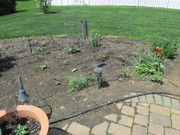
I absolutely must take lawn and garden photos for posting. The last two warm days have accelerated things here amazingly, and the daffodils are in full bloom.
Sunday, March 31, 2013
The Great Aphid Attack of 2013
It happened last year as well. The plants growing in the cellar weren't looking grand, and finally started to fall over dead. Inspection with a magnifying glass (as my eyes are terrible) showed a massive aphid invasion.
Last year's attack was awful, and not caught until far too late. I ended up losing an entire flat of red salvia, and replanting them in early April. Although they ended up doing perfectly well, they were very small when they went outside and blooming was severely delayed.
This year I was expecting them. And lo and behold, there they were at the end of March. Although they damaged the Melampodium enough (and the spray I used did enough damage) that I replanted those, the salvia were untouched, as was everything else.
Treatment for aphids is quite simple. You can use a water spray, as from the sprayer on your kitchen sink, to blast them off. Most of them will wash down the drain. Repeat this every four to five days.
With 12 flats, that's a bit unrealistic. I mixed up 1/2 tsp dishwashing liquid in 1 pint of water and sprayed the plants thoroughly. Aphids absolutely detest soap, and it kills them.
Repeat four days later, and then keep an eye on it. Some plants may not handle the soap well, as my Melampodium didn't, so you can also use any indoor-safe insecticide made for a wide spectrum of houseplants. Remember that your young annuals are very tender, so test before use and monitor after usage very closely.
Saturday, March 23, 2013
More Annual Selections
This gardening thing works better if you can count correctly. Which, apparently, presented a problem for me this year. In my defense, it wasn't completely my fault.
I've discontinued most of the cup-based plants, so I picked up half a shelf. A bit of rearranging and higher counts on the cells in the flats gave me another half shelf total. So I really have space for 2 extra flats.
Plus the Scarlet Dreamland Zinnia didn't have the best sprout percentages. That's putting me a quarter of a flat short right there.
So I placed another order with Parks', as there's still plenty of time to wait for delivery and plant the seeds. I selected the following:
More Scarlet Dreamland Zinnia: They're a staple, and I'm short on reds anyway.
Profusion Double Hot Cherry Zinnia: Did I mention I'm short on reds?
Coral Dreamland Zinnia: A bit off the beaten color trail that I tend to follow, but striking enough to work in a garden with dominant colors.
Night and Day Snapdragons: About that being short on reds thing... These are more of a deep scarlet and cream, but very pretty and dramatic enough for where I want them. I've never seen these before, so here's the link: Night and Day Snapdragons
Time's a bit short on the snapdragons, so I expect those will be small, will have a limited spring blooming cycle, and should do better in fall. I have those planned for a mostly-sunny location protected from the worst of the heat, so they should do fine even in summer.
Friday, March 15, 2013
Seeds: The Ides of March
It wasn't the best day for Julius Caesar, but it's a day of some import for northern plant growers.
Today begins the part of the season when your fast-developing plants can be started! Marigolds, cosmos, zinnia, petunia plugs, and almost anything else are now in play!
You have a wide window, however. We're now five to six weeks out from the planting dates for most of us in PA, NJ, and southern or coastal NY (it's a bit longer for areas in central New York and the rest of New England, the Midwest states will vary). Cosmos will develop enough to be planted outside in two to three weeks, although having longer is nice. Mine went last week--I have to play with the windows a little bit as I have over 1,000 plants to go.
Marigolds will do fine if your seed is planted before about April 10th. Zinnia and most others, the same.
If you still have work to do, don't despair. Although technically too late for many things, you can still plant them. Just realize they'll be smaller than average when placed outside and may require a little more time to develop and bloom for you. Even salvia will be fine up until the beginning of April, but they will be small.
Saturday, March 9, 2013
March Lawn/Garden Photos
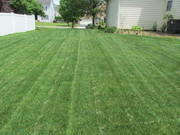
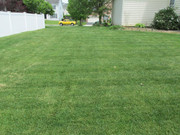
The lawn's returning very quickly this year as the photo below shows. I mowed for the first time to remove the dead tips and expose the green grass underneath. As with any photo, please click to embiggen it.
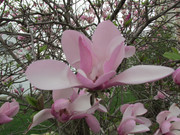
The weather looks fairly good for the rest of the month, with lows not going much under 20°. That should be sufficient to keep it from going to sleep, particularly with daily highs in the forties and fifties through the period.
I took my soil samples today as well, for both the lawn and gardens. As always, this is an exercise in moving the worms out of the way so I can get the soil!
Here's the very first blooming flower in the garden this year, a yellow crocus. Both of these popped open today. They're in one of the most sheltered areas of the garden, so this small patch is usually the first to blossom. The rest will wait a week or so before opening their blooms.
Saturday, March 2, 2013
Start More Seeds Now!
For those of us in the northeast, we're eight to ten weeks out from last frost (for me, that's usually around May tenth). It's time to start some of the middling varieties of seeds, mostly things that require 60-80 days to bloom from seeding.
I started the Cosmos, Texas Bluebonnet, giant Zinnia, and Easter Eggplant last week or this week. I rounded out with some Dreamland Scarlet Zinnia, which don't require the time but won't be hurt by being a bit pot bound for a few weeks.
If you stagger sunflowers to have blooms through the season (usually done with shorter ones as the very tall sunflowers like Mammoth require a long growth period), starting the first ones now isn't a bad idea. I usually plant three or four dwarf sunflowers, staggering planting every 2 weeks and finishing up with the last planted around April first.
Most shorter zinnia, marigolds, nasturtium, and petunia can wait a bit yet. They don't require a great deal of time to bloom.
Thursday, February 21, 2013
Seed Starting Success!
First sprout was yesterday on the Melampodium, and very late day yesterday on the dahlia.
As of this morning, I see the Mimulus (monkey flower) just starting to poke up.
On average, that's about four to five days (I started some on Saturday) for first sprout, and should be another 2 days until sprouting is complete and they're ready to go under the lights downstairs.
That's actually fairly fast, but I find the seedling heating mat I use raises the temperature of the soil to about 80, and that tends to accelerate the sprout. For non-heated seeds, seven to ten days to first sprout isn't unusual.
Using something like a space heater isn't recommended. Temperatures will rise too high, and the seed slows sprout. The fifteen watt seedling mat I use is just about perfect.
Sunday, February 17, 2013
Starting Seeds--It's Time (for Some!)
It's just about time to start the seeds for the garden that take a while to develop.
It's actually getting a bit late for some, like Lisianthus. Those should have started in January or even December.
As of today, Melampodium (butter daisy), the slower dahlia, and Mimulus (monkey flower) got started. As soon as I clear my office of those and get my warming mat freed up, I'll start the Salvia farinacea (blue salvia).
Red salvia can wait a few weeks yet. Marigolds, zinnia, and the like can wait until March 15th to April 1st.
Friday, January 4, 2013
Annual Selections
I made my annual seed selections today for the 2013 gardening season. I noticed last year that cool-season plants did very poorly, and I ended up losing most of the Impatiens in the garden. While I may repeat them this year, I think I'll include fewer.
I tend to purchase the plants that I use in small numbers. Those include Impatiens (12 plants or so), petunia (3 or 4), and sometimes a flat of Janie gold marigolds as I can't get the seeds through my preferred suppliers. I use an overall total of 11 to 12 flats and grow 10 of them in the cellar on a light rack that I constructed (there are posts about that on this blog).
The plan this year is much the same as last year--a great deal of red, yellow, and orange, offset with blue. I liked the contrast and colors very much.
This year's list of plants is as follows. Heirloom plants are non-patented varieties where I collect seeds from the last year's plants and grow the next year from them.
Red Salvia, crossbred, heirloom seeds from the garden. These tend to get slightly taller and flower more heavily every year. Eventually I'll need to mix in some smaller varieties to reset the heights. Right now they're about 30 inches tall, typically have eight or so flower spikes at a time, and flower from May through frost.
Salvia farinacea, crossbred, heirloom. These don't seem to change much year to year.
Melampodium (butter daisy), crossbred, heirloom. These also seem to be getting taller and much more heavily blooming.
I purchased Double-Take Cosmos from Burpee this year as per spousal request. I have the perfect places for them! They're a gorgeous bi-color cosmos of moderate height. I've had excellent luck with Burpee seeds in the past.
I buy most of my seeds from Park Seed as I love the high quality and healthy plants I get.
This year, I bought from Park:
Easter Egg Plant: A neat accent for the garden. I'll plant six or so.
Harlequin Mix Dahlia: Another spousal request. I also love dahlia, so that's not an issue, and they work well in the garden. Their more nodding flowers and slightly more delicate colors make a nice resting place for the somewhat overwhelmed eye.
Mimulus, Red and Yellow Magic Blotch: A pretty and striking bi-color. Monkey Flower (Mimulus) does well in full sun in Pennsylvania but tolerates partial shade very well.
Dreamland Scarlet Zinnia, Dreamland Yellow Zinnia, Profusion Double Fire Zinnia: Both Dreamland and Profusion are relatively disease resistant. I had a little trouble with the red Magellan Zinnia, although the yellow did very well in my garden.
Janie Flame Marigold, Janie Primrose Yellow Marigold, and Aurora Gold Marigold: I've always loved Marigolds for their bold colors and constant bloom. Yes, they're common. There's a reason for that!