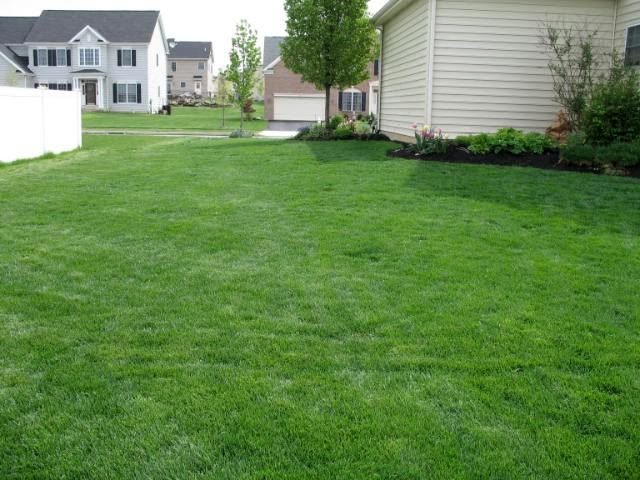
Summer isn't even thinking about winding down yet, but organics take a while to work in. I added 110 pounds of soybean meal and another 72 pound of Milorganite to the lawn over 7,000 square feet--I usually don't feed the swale, but I've done considerable work back there and it could use the energy to spread.
For those of you playing along at home, that's 1.6 pounds of nitrogen, which is a very heavy feeding for July. That's on top of the 1.7 pounds that went down at the beginning of the month. Fortunately there's no chance of burning it, and the number of worms is exploding again.
This is the last year I'm going to be striking it this heavily.
I have to take photos of this. The lawn resembles June more than July (however, so does the weather around here), and is an incredible dark green with an aquamarine overtone. The color is more from the iron than the feeding, however.
Wednesday, July 22, 2009
Another Heavy Feeding

Saturday, July 18, 2009
Beginning Composting
Our township gave away (well, paid for by my taxes) 95 gallon yard waste containers. My mother had a 65 gallon container with a small hole in the bottom which she wanted to get rid of, so I took it.
An hour later with the drill, it looks like it was used for buckshot practice by somebody who can't aim very well. I can't tell you how many holes are in it...one every inch to an inch and a half all over the container.
I tossed in some leftover sod after bashing off the soil and ripping it apart, followed it up with a pile of lawn weeds and a bit of shrub cuttings, and shredded some plain paper junk mail to get some browns into the pile. Half an ounce of molasses got added with some water as well to start the process.
I'll initially turn the pile in the next week to mix everything once I'm done weeding the gardens again, but after that it's going to be relatively unturned. Every once in a while I may get around to it.
I'm hoping that, filling it by August, I have compost next spring.
Wednesday, July 8, 2009
More Corn and Milorganite
I fed with another 50 pounds per thousand square feet of cracked corn today, and added another 18 pounds of Milorganite on top of that. Hopefully the Milorganite will repel the birds and rabbits a bit.
Our weather is holding more like early June than July and we're still getting sufficient rain, although June's deluge seems to have stopped at least temporarily. While I wouldn't normally feed that heavily in July, this year won't be an issue.
Looking at the soil condition lately, this is the last year I need to apply at these incredibly high rates. The soil's finished transforming from solid clay to something much more friable. Technically, I could stop now, but there's no issue with continuing through the end of the season.
I do need to update the photos as the lawn is continuing to darken from the iron applications. I'll wait until I mow to do that.
Sunday, June 21, 2009
Another Photo!
A nice sunny day makes a huge difference when you have enough iron! As always, click to embiggen: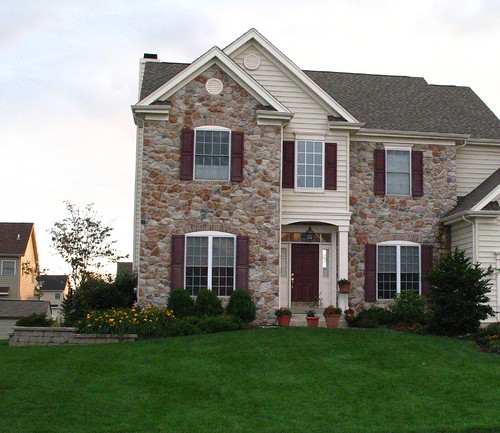
Saturday, June 20, 2009
Image Update
I took this photo about 20 minutes before sunset tonight. I added 2 pounds per thousand of ferrous sulfate just before it rained, and sprayed the lawn a grand total of three times for 5 ounces of iron per thousand total as a foliar application.
That is a lot of iron, but once temperatures during the day start rising above 80 I'll be less able to add it without burning. That will probably be the last soil application until late August. By the numbers, 11 pounds of iron per thousand square feet should have raised my iron levels to around 45 parts per million, but my soil's slightly alkaline state will enable it to bind most of that.
As always, click the photo to embiggen!
Saturday, June 13, 2009
Chelated Iron
I picked up some Bonide #299 Liquid Iron Complex quite cheaply (about a third the usual price), so I've applied that to the lawn.
The recommended rate for bluegrasses is 2 to 6 ounces per thousand square feet in enough water to apply it, and then spray to runoff. I diluted 2 ounces in 1 gallon of water and found it made a slightly thin spray. Next time I'll dilute half that in a gallon and go 500 square feet.
The hydrangea, which was a touch yellow, is showing a response in just a few hours. The grass should take 1 to 4 days to show any change at all. Since I went at 1/3 the normal rate, I may also have to apply more to achieve the color I want.
Wednesday, June 10, 2009
More Corn and Kelp
Summer's about to heat up here in PA (if it ever stops raining), so I've added 50 pounds per thousand of cracked corn and 8 pounds per thousand kelp meal to help prepare for it, feed the lawn over summer, and help fight the fungi from all the rain we've had.
It looks like my ferrous sulfate will arrive Friday, so I'll be soil drenching on Saturday.
Monday, June 8, 2009
Iron Oxide
Since iron oxide (Fe3O4) is so incredibly cheap, I've added 20 pounds over six thousand square feet, or about 3.3 pounds per thousand square feet. I'll report back later on the results.
One minor note is that if you can get it in granular form somehow, do so. The powdery stuff goes everywhere, even when mixed with Milorganite to even out the distribution.
Sunday, June 7, 2009
Thuja standishii x plicata (Green Giant Thuja) Update
The new Thuja, which I had estimated at a six inch growth rate this year, have grown considerably in two months already. The winner is a bit over 24 inches of increased height, the laggard is around eight inches taller. Since growth continues until August or so, these may get considerably taller than they already are.
Right now, width is fairly stable but increasing slowly.
Friday, June 5, 2009
Milorganite vs Ironite
I keep seeing this search and thought about it for a bit. It's a good question.
First, the basics. Milorganite is 5-2-0 fertilizer with 4% iron and a few micronutrients in it. Ironite is 1-0-1 additive with 4.5% iron and a host of micronutrients in it. I hesitate to call Ironite a fertilizer when it has such low numbers.
So which should you use? What are you trying to do and what do you need?
For standard lawn feeding, the Milorganite is definitely the better choice. The iron in it is sufficient to green your lawn without burning it, and the nitrogen is organic and also will not burn.
If you have chlorosis (an iron shortage) or a known shortage of the other nutrients in Ironite, the Ironite is the superior choice. The nitrogen is water-soluble, but there isn't much at only 1%. The iron, at 4.5%, is slightly superior to Milorganite and will green the lawn faster.
To determine if you have a shortage of the micronutrients in Ironite, you should have your soil tested.
Many people state that Ironite (and, for that matter, Milorganite) have too many heavy metals like lead and arsenic. Milorganite meets the highest standards for fertilizer, and Ironite's heavy metal numbers are very reasonable for usage while correcting a shortage. I wouldn't use it as a matter of course, however.
I certainly don't advise the use of Ironite without a soil test as adding micronutrients you don't need is at best useless. At worst it can damage your lawn and gardens.
If you'd rather not add any level of heavy metals but do need iron, ferrous sulfate is another source. Usage will depend heavily on your soil pH and local conditions, so some research is necessary.
At this point, I've used Ironite three times this year. From this point forward, I'll be using ferrous sulfate instead as I don't feel comfortable increasing the other elements any more than they already are.
For other micronutrients, most are available in a sulfate or other form. Those numbers should be calculated by an expert, and you can visit the Bestlawn soil management forum for much more information.
Monday, June 1, 2009
Adjusting Micronutrients
I've ordered a pound each of manganese sulfate, zinc sulfate, and copper sulfate to shift my soil levels slightly. Although not far out of the normal range, I'd like to adjust those into the sweet spot for optimal growth of the lawn and gardens.
The chemicals are kind of festive. Zinc sulfate is white, copper sulfate a blue-green, and manganese sulfate a faint pink.
The iron I've dumped (around 5 pounds per thousand) is already binding and the color is decreasing. It looks like I need to add either iron oxide or ferrous sulfate, depending on which one I determine will do the best job. Given my pH of 7.2, I suspect it'll be the ferrous sulfate.
Given that pure ferrous sulfate is around 30% iron, it doesn't require much--no more than a pound or two per thousand square feet at a time, never to exceed 10 pounds per thousand per year. That must never be applied to a wet lawn, and should be thoroughly watered in immediately after application.
Friday, May 22, 2009
Photo Update!
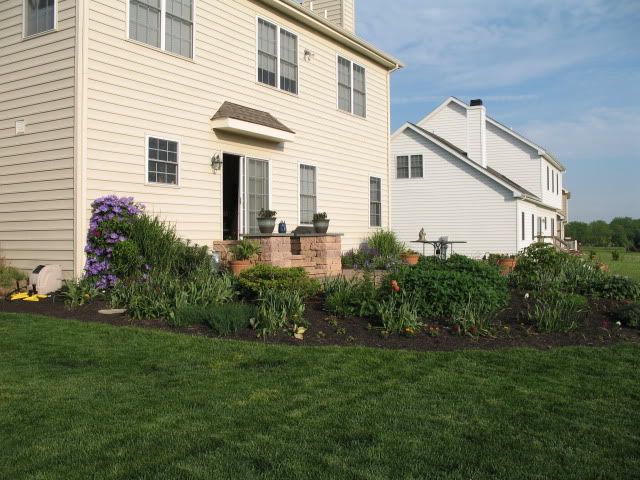
The iron has definitely kicked in, and the gardens are beginning to show some nice flowers.
This, after three years of organics, is very close to the lawn I want. I have some nutsedge to get rid of, but that's turning yellow and dying out now. Walking on this is like walking on a cushion.
As always, click to embiggen!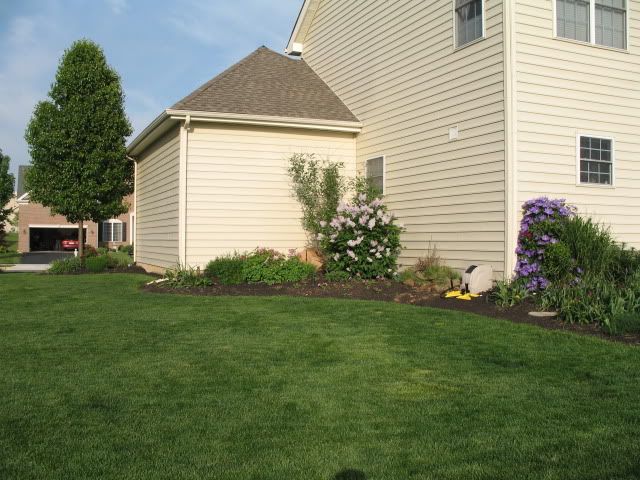
Wednesday, May 13, 2009
More Milorganite and Ironite
I've just applied 4 more bags, 144 pounds, about 25 per thousand of Milorganite to the lawn. Additionally, I added another 4 bags, 160 lbs, of Ironite to continue to increase the iron levels. The grass is definitely less chlorotic and I'm hopeful that next years' soil test will show considerably improved iron levels.
I'm still working on the annuals, but I'm close to completion. I picked up a few heliotrope and Gerber daisies for pots, but I don't think I need anything else.
The Certainty application from earlier on the nutsedge is definitely working, although I may still patch some of the larger areas.
Sunday, May 10, 2009
Certainty on Quackgrass or Nutsedge
I have a little nutsedge (it could be quackgrass; it doesn't matter much), so I've sprayed those bits with Certainty at 0.75 ounces per acre equivalent.
I'm hoping that will knock it out. If not, I still have enough donor sod to repatch the entire area with plenty left over.
The annuals are now going in as well...ten flats worth. This year, I've used marigolds, salvia (red and blue), ageratum, dwarf snapdragon, rocket snapdragon, Orchid Madness petunia, star sapphire petunia, alyssum, Impatiens, Gazania, verbena, Melampodium, annual phlox, and cannas.
I'll take photos once they start to grow a bit. I won't finish until the middle of this week, I think.
Friday, May 8, 2009
Photo Update!
It's been some time since I updated the images. Here's the lawn as of yesterday. The color is a little chlorotic, but it's been raining for eight days. That will recover fairly quickly, and the last of the holes are filling in now.
As always, click to embiggen!