Monday, November 23, 2009

Final Fertilizer for the Gardens

I put down 108 pounds of Milorganite today to increase the organic levels (54 pounds per thousand). That's the last feeding for the garden.

Here's the entire list of what's gone down this year:

Date N P K Iron Organics Notes
2/21/2009 0.90 0.36 0.00 0.72 18.0 Milorganite
3/7/2009 1.61 0.23 0.46 23.0 Soybean Meal
3/21/2009 0.41 0.16 0.10 25.0 Corn Meal
3/28/2009 0.73 0.25 0.83 35.0 Alfalfa, Kelp
4/4/2009 1.65 0.23 0.47 23.5 Soybean Meal
4/21/2009 1.50 0.60 0.00 1.20 30.5 Milorganite
5/30/2009 0.88 0.25 0.00 12.5 Soybean Meal
6/25/2009 0.90 0.36 0.00 0.72 18.0 Milorganite
7/20/2009 1.40 0.40 0.20 20.0 Soybean Meal
8/3/2009 0.90 0.36 0.00 0.72 18.0 Milorganite
9/13/2009 3.15 2.39 0.60 25.0 Starter, Soybean Meal
10/10/2009 3.20 2.61 0.35 1.44 36.0 Starter, Milorganite
10/26/2009 1.62 2.16 1.08 0.00 Starter
11/11/2009 3.15 2.52 0.90 1.44 36.0 Starter, Milorganite
11/23/2009 2.70 1.08 0.00 2.16 54.0 Milorganite
Total per K ft: 24.70 13.96 4.99 8.40 375.5 751 active organic total

Monday, November 16, 2009

Still More Leaves

I've finished the lawn--with 2,000 pounds of leaves in 97 bags, or a cube 8 feet on a side (and a bit).

Any remaining stock will go to increasing the leaf mulch on the drier southern face, plus repairing the soil in the areas the Township damaged and still hasn't fixed (on day 12 and still going!)

However, any remaining stock is going to be limited. Last weekend's storm took down most of the remaining leaves, and I expect about 20 more bags before the end of leaf season.

Thursday, November 12, 2009

The Last of the Milorganite

For the season, anyway! I put down 108 pounds over 6,000 square feet (about 18 pounds per thousand), and went heavily through the Township-damaged areas. I'll follow up with photos of those when I can face them...

Normally I'd publish my entire year of organic additions, but I'll hold off until the leaves are done. I'm still importing them at a fairly high rate.

The Winterizer is yet to go, but that has to wait for soil temperatures to fall under 40. So far, that looks like it won't happen for some time yet.

More Leaves

I've applied around 1,750 pounds of leaves to the lawn and I'm close to 80% complete at this point. The first areas of application are already invisible even applying at nearly 300 pounds per thousand. After a short period, the leaf litter breaks down into black organic matter that's invisible on the soil.

My current estimate is around 2,000 pounds of leaves (a full ton!) to complete the property. That should raise organic matter about half a percent in the soil.

Wednesday, November 4, 2009

Roses in November! Bonus Photo!

I put in a Double Knockout rose in the back, and performance so far has been spectacular. I was careful to organically prepare the soil with two handfuls of cracked corn and two handfuls of alfalfa hay while planting, plus I've applied Milorganite, soybean meal, and large amounts of additional alfalfa throughout the season. For some reason, roses seem to love alfalfa. I also spray the bush and surrounding soil with liquid iron, kelp extract, and a small amount of humic acid.

This rose opened November first. Today is the fourth, we've had six or seven frosts, and the rosebush just keeps blooming. There are fifty more on the bush that look just like this...and no, I did absolutely no touching up of this image.

Mulching Leaves on Your Lawn

In the past few weeks I've tapped two other properties of leaves to add to my own--with permission, of course. Both are kind enough to bag the leaves for me so I don't have to do it, and I'd like to extend my thanks (you know who you are).

So far, I've finished around 60% of the lawn and applied approximately 1,200 pounds of leaves (with some cut grass in the bags as well). I'll require a total of 1 ton of leaves, which works out to 285 pounds per thousand square feet.

So what do leaves do? They raise the organic matter percentage in the soil, provide fall food for your worms and micro-arthropods living in your soil, encourage bacterial and fungal activity in the soil, and mulch the soil for winter. Lawns that have been leaf mulched will retain their green color further into winter, green up faster in spring, and generally show greater health than lawns that receive no mulching.

How much should you use? Close to 300 pounds per thousand square feet disappears into the grass in a few days if well-chopped, but applications certainly do not have to be made at that rate. This study shows the results of mulching 150 to 450 pounds of leaves into the soil, and effects are generally excellent.

But isn't leaf litter ugly? Well, yes. The above study states that leaf litter at the highest application resulted in leaves still left on the lawn in spring. However, if you have a rotary mower it becomes easy to render the leaves invisible. With the very large amount I'm using, I mow slowly four times over the area to reduce the leaves to bits smaller than the nail on my pinky (and I have small hands!) By the time I complete the task, almost no visible litter remains--99% has fallen into the grass and becomes invisible. The remaining 1% disappears with the next rainfall.

What's the NPK ratio of leaves? Don't worry about it. Trees extract almost all the chlorophyll and nitrogen and place it in root storage for the winter. There is a small amount of phosphorus in the leaves, so mulching them is better than allowing rainwater to percolate through them while they sit on the street (my other post from today mentions eutrophication; leaves are one source of phosphorus that enters our waterways). Potassium levels are fairly low. The reason leaves are mulched isn't to feed the lawn but instead to provide additional organic material for the soil.

I've Been Busy

Whew, sorry for the posting delay! I've applied 2 more applications of starter fertilizer, bringing my calculated phosphorus amount to 25 PPM. If that's correct, even at the pH of the lawn soil (7.2), I'm exactly at optimal phosphorus levels.

Please note that starter fertilizer should only be added after a soil test that shows you need it. Excess phosphorus can leach into water sources, causing eutrophication of lakes and streams. Eutrophication means that algae growth increases, oxygen levels in the water drop because of bacterial action, and fish have a difficult time surviving.

Many soils have sufficient phosphorus levels and won't require enhancement. Mine, however, did not. The lawn density has increased amazingly from rebalancing the soil for the final time this year and I'll be certain to take photos.

I've also applied Milorganite four times for a total of around 400 pounds, or approximately 60 pounds per thousand. That should help raise the organic matter tests for next year, as well as increase the iron above the 1.4 PPM test. However, the soils are still visibly iron-short and require spray applications to maintain color--I prefer Bonide #299, but any iron source will do.

I've also mulched large amounts of leaves into the lawn, but if you read the other post from today you already know that.

Sunday, September 27, 2009

The First of the Fall Milorganite

I've fed with 108 pounds of Milorganite (15.6 pounds per thousand square feet) to start the fall feeding on the lawn. I can certainly use the iron, as well.

This year, Milorganite continues to be added every two weeks either through the end of October or beginning of November, depending on how the weather plays out.

I've passed well over 5,000 pounds of material for the year so far, and I'm approaching 800 pounds per thousand square feet.

Friday, September 25, 2009

The Last of the Boron

I sprayed the lawn with the last of the boron for the year, one teaspoon per thousand square feet. That should be enough to raise my boron levels from 0.4 PPM to around 0.8 PPM.

Boron's role in plants isn't clearly understood. It does help meristem cells differentiate into blade and root cells. Lacking it, the cells elongate but don't differentiate. Grasses aren't particularly sensitive to boron deficiency, but it's always best to adjust micronutrients into the optimal range if you're comfortable doing so.

Boron is also the touchiest of the micronutrients. 0.4 PPM is slightly deficient, 0.8 PPM is optimal, and sensitive plants will begin showing toxicity symptoms around 1.0 PPM. Only add boron after a soil test shows that your soil is deficient.

Tuesday, September 22, 2009

Starter Fertilizer

It looks like rain out there, so I put down 21 pounds of starter across the lawn (about 3.5 pounds per thousand). My soil test last spring came back at 9 ppm phosphorus, which is a touch low. I'm hoping to increase that into the 12 to 15 range by next year, which will be sufficient for good growth.

I'd use bone meal, but I have trouble getting enough and the starter fertilizer is a much more rapid source.

Phosphorus is used for energy transport and storage within the plant cell, as well as being an integral part of the RNA and DNA molecules. In flowering plants, it assists with flower production, although that isn't an issue on the grass. I did, however, add some to the gardens as well to work in by next spring.

Friday, September 18, 2009

It's Been A While

Sorry for the delay folks.

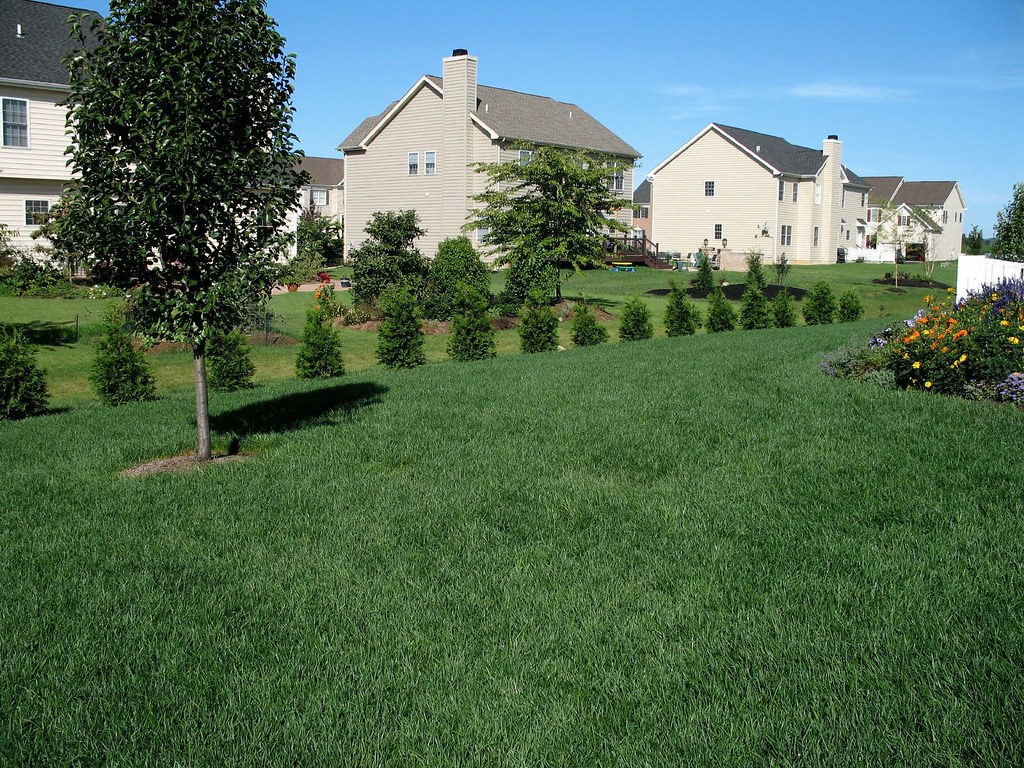
Here's a recent image of the lawn. I think the iron levels are finally starting to come up! This is post adding 4 pounds of sprayed iron sulfate from Bonide (the bagged, powdered stuff you can get in most stores). A week later, the color still hasn't faded.

The last 350 pounds of corn went down August 25th with a bit of Milorganite. So far in September I've fed twice with 150 pounds of soybean meal. I've moved 5,022 pounds of organic material this year, or about 775 pounds per thousand.

For the remainder of the year, Milorganite is the heavy-hitter. It works better as soil temperatures cool a bit.

Saturday, August 15, 2009

Um...and Again

I just dropped another 350 pounds of cracked corn on the lawn and the birds, at least, are pleased with me.

This is the second last drop at this level for the year--in fact, for a good long time, if not forever.

I just passed 2 tons of material on the lawn and gardens this year, or well over 650 pounds per thousand.

Tuesday, August 11, 2009

I Fed Again...

We're moving toward September, so down went another 350 pounds of corn meal, 3 bags of Milorganite, and about 40 pounds of leftover compost (scattered very thinly across the property). That works out to about 80 pounds per thousand.

Fortunately, this is the last year. My back hurts.

Wednesday, August 5, 2009

An Updated Image

It's been quite some time since I posted an image of the lawn. Things are doing well, barring the occasional bit of P. annua and P. trivialis.

As always, click to embiggen!

Sunday, August 2, 2009

Still More Feeding and Compost Update

We're getting a large amount of rain this week, so I put down another 350 pounds of cracked corn and 72 pounds of Milorganite yesterday. I fed the swale again to prepare it for fall.

That's down to another 1.3 pounds of nitrogen, but I'm adding it more for the soil changes than feeding the lawn.

The composting is working well in the free garbage can. The first load was very heavy on torn up sod, so it didn't break apart very well. I added more shredded junk mail and garden trimmings and the pile is now at 144°. Hopefully that will break apart the sod a little more.

At this rate, I should have a load of compost by the end of September, just in time to start composting the fall leaves.