I dropped the third fall feeding today, fifteen pounds per thousand square feet of soybean meal (the first was also soybean meal, the second Milorganite).
That should kick in around the end of September and supply ample nitrogen through October.
The last organic feeding will be around October first, to release toward the middling-end of October and into November. The remainder of that final feeding will freeze and release small amounts of nitrogen through spring, sufficient to carry me through May and the first of the major yearly feedings.
The absolute final feeding for the year is synthetic, and done whenever top growth ceases. That's usually around Thanksgiving, give or take a week. This year, I chose Vigoro Super Green as it was in stock when I went, and the cheapest thing available.
Monday, September 9, 2013
Lawn Feeding, Soybean Meal

Sunday, September 8, 2013
Easter Eggplant--Collecting Seeds
The Easter Eggplant (featured in earlier posts) is maturing beautifully, with "eggs" turning yellow and then a burnished orange that's the perfect color for September. I can't recommend these plants highly enough, but do recommend putting them in pots where you can more easily enjoy the eggs. The flowers are also quite pretty, but small and easier to see if they're somewhere closer to eye level.
With the fully mature orange color, it's time to collect seeds! Although there are plenty of methods that work well for all eggplant, including the blender method, I chose the glass of water method.
Pick an eggplant (be careful, they have small thorns on the stem). Fill a glass half full of water.
Cut the top stem portion off the eggplant. You can cut as deeply as about a quarter way through the eggplant without losing too many seeds.
Then quarter the eggplant. You can pull apart the seed containing areas by peeling back the yellow-white "meat" and exposing the seeds in layers. Your thumbnail will be sufficient to free the seeds. Dip your fingers containing the seeds into the water.
Repeat until you have all the seeds you want (it's best to take seeds from several plants to preserve as much genetic diversity as possible). You may notice a few seeds float to the top, and all the excess eggplant meat and rind will also float.
Carefully pour off the water down to the seed layer but don't lose the seeds! Then refill with water again and repeat pouring off. Do this a third time and the water should be completely clear.
Dump the seeds onto a plastic or china plate (seeds will adhere to paper) and spread them out as well as you can.
They'll tend to stick to each other, so do your best. Let dry for a day or so, and spread them again. Then dry for a week in a location out of direct sunlight and store for the winter.
Eggplant seeds tend to do best if they experience vernalization, or the process of simulating winter and then raising temperatures for spring. I may do an extended entry on this in the future as I now have two species that benefit from vernalization (the other is cleome).
Storm Damage
We had vicious thunderstorms blow through on Labor Day, including more than 3 1/2" of rain and violent winds. Parts of the garden took some damage, most notably the tallest and most exposed of the cleome.
Most of the shorter plants, including the marigolds, zinnia, ageratum, and so on came through unscathed, as did all the trees and shrubs. As a general rule, larger and more spread-out annuals will tend to be damaged most easily by winds.
When this happens, there's very little you can do. Remove any broken branches, re-seat any plants that have been shifted, and hope for the best.
Damage will tend to occur toward the end of the season, so at the very least you don't have long to look at it. Early season plants are smaller and more flexible.
In my case, much of the mass was chopped and composted, and the damage wasn't terrible. One cleome that I couldn't re-seat will simply lean a bit for the remainder of the season.
Sunday, August 18, 2013
Milorganite Down!
I hacked down the jungle-like growth out there that a week of intermittent rain set off. This morning, 13.6 pounds per thousand of Milorganite went down as an interim feeding. I should be noticing increased green from the iron by mid-week as we're getting some rain today.
I'd fed with soybean meal on July 28th, just before an earlier rainy period, and will feed again around September 10th with soybean meal. The final organic feeding will be around October 1st, with winterization around Thanksgiving using a synthetic.
Yes, fall is the time to feed your lawn. Synthetics should wait for
the temperatures to break downward a bit (we usually say Labor Day).
Organics can start any time from August first through Labor Day and be
just fine.
Optimally, you'll want to deliver about three quarters of your lawn's
nitrogen in fall as more of it goes into root storage and development
than in spring. Feeding once around Memorial Day is sufficient for the
spring lawn.
The other feedings, assuming using an off-the-shelf synthetic, in my
area are Labor Day, October first, and whenever the grass stops growing
(for me, around Thanksgiving).
That last one is actually the most important as almost all the
nitrogen is transformed into carbohydrates and stored for winter.
Winter survivability rises dramatically in lawns that were
"winterized," or fed just after cessation of top growth.
Since my area inconsistently freezes, I use Vigoro Super Green with a
goodly percentage of slow-release nitrogen. Areas further north would
do better using the cheapest fast-release (no "WIN" listed under
nitrogen on the bag's nutrient panel) fertilizer you can lay hands on at
bag rate.
Monday, August 12, 2013
What Works Faster: Milorganite or Ironite?
This is another question that showed up in my search results--apparently Milorganite and Ironite are frequently compared head to head.
They really shouldn't be as they're completely different things. Milorganite is an organic feeding that happens to contain a large percentage of iron. Ironite contains a large percentage of iron and happens to contain a very tiny amount of nitrogen.
As far as speed of greening, both Milorganite and Ironite will give essentially identical results. Enough of the iron is water-soluble that it'll reach the roots at about the same speed for each product after watering in (or rainfall). While Ironite has a bit more iron, it's not significant at bag rate applications.
As far as feeding, Ironite will give a tiny boost of nitrogen. Milorganite will give a much larger one (there's ten times more nitrogen in Milorganite), and about two-thirds of the nitrogen in Milorganite releases over the long term. Organic nitrogen requires time to decay, process, and become available to the plant roots.
Milorganite will help enhance your soil over time as well, although the process is rather slow--on the order of years, not weeks or months.
If you read my posts from this weekend, Milorganite is the heavy-hitter in my gardens (and often in the lawn, although less so this year). Ironite...I don't use the stuff, personally, as the unit price is more expensive when comparing both the iron and the feeding capability of Milorganite. Add in the soil alterations and there's no comparison. It's Milorganite hands down!
Sunday, August 11, 2013
Easter Eggplant
Easter Eggplant is an eggplant that produces fruit the size and shape of Grade A chicken eggs. The "eggs" start out a creamy off-white, something like eggshells, and turn yellow as they mature. Colors can range into orange as they get older.
As it turns out, that description of the Easter Eggplant is accurate. Several of the older eggs on my plants are beginning to turn, and I discovered a set this morning that are now fully yellow. They're on one of the most beaten-up plants in the corner of the garden that sits in full sun all day long.
As always, click on the photo to embiggen it!

Watering in Milorganite and Soybean Meal
I noticed a search term rising in my stats report and it's a good question. How much water does Milorganite need?
Technically, none. You don't need to water in an organic fertilizer to get it to work. Natural rainfall will do that for you very nicely, and neither Milorganite nor soybean meal (nor any other organic fertilizer) will burn if you don't water it in. That assumes you've applied a reasonable amount as large amounts of Milorganite can burn, but bag rate to double bag rate certainly won't be a problem.
Milorganite contains some water-soluble nitrogen, so until it's watered in nothing is happening at all. Around a quarter inch of rainfall or irrigation is sufficient to move that water-soluble N into the soil to start work.
Soybean meal contains no water soluble nitrogen, so there's no immediate nitrogen release at all when watered in no matter how much water you use. Other organic fertilizers will vary, but the percentage of water soluble nitrogen will tell you how much effect to expect immediately after watering.
The remaining sixty percent (or 100 percent for soybean meal) of water insoluble nitrogen has to decay and break down in the soil to become available to your plants. That's dependent on moisture as well, so a constantly slightly to moderately damp environment will feature the fastest nitrogen release.
Too much water tends to expel oxygen from the soil, which is necessary for decay. Soy and Milorganite will still decay under anaerobic conditions, but the results aren't quite as good. Too little water will shut down decay and stop nitrogen release until rainfall resumes.
This is actually a good thing. Soils that are too wet or too dry don't foster large amounts of plant growth to begin with, so reduced nitrogen release is appropriate for what the plants need at that time.
Saturday, August 10, 2013
My Garden Secret
OK, stop hassling me via e-mail. You know who you are. :-)
There are actually several secrets to making your garden bloom like this.
1) Get A Soil Test. Just like the lawn, or your vegetables, they're stuck in the soil. They can't move. You as the gardener will need to balance the soil appropriately, so get a soil test. I prefer Logan Labs.
Reading it can be difficult. For the most part, you want saturation percentages of 60% calcium, 15% magnesium, 10% potassium, 15% everything else. Give or take some, and it does depend on what you're growing--those numbers are for typical annuals.
As a general rule, 250-500 PPM phosphorus is best for flowering gardens, but I've pushed mine far higher. You don't really need to do that.
Adjust things appropriately and your gardens will bloom.
2) Milorganite. 18-36 pounds per thousand square feet, applied monthly. Milorganite will provide some water-soluble nitrogen, but also adds plenty of organic nitrogen that will take a while to decay into your soil. At first, those amounts may be too large and you may find that it smells very bad as it decays. If so, back off for a while until the scent fades and apply at lower levels the next time. Slowly step it up.
Milorganite is probably the most important feeding I give the gardens.
"I can't get Milorganite!" -- I've also used soybean meal to excellent effect and do occasionally use it instead of Milorganite.
In neither case do you have to specifically water it in. Both the Milorganite and soybean meal will start work the next time you water or it rains, and neither will burn your plants if it sits on the leaves.
3) Water. Wilted, stressed plants won't bloom. Dead plants definitely won't bloom. Keep the soil evenly slightly moist at worst all the time. It's best to water far enough before sunset that the plants have time to dry thoroughly before dark. That reduces fungus issues and also helps keep slugs down a little bit (not much).
4) Other feedings. I have an EZ-FLO hose-end system and use it to inject a quarter-rate feeding once per week into my gardens. Roughly, over the course of a month, I use the same amount of water soluble food that would be recommended for a week.
A hose-end feeder will work just fine. If you're following Tip #2, you don't need a great deal, but it's wise to trickle in a little bit often. Just pass over the plants once, then water in or let the rain carry it in for you.
While I use 15-30-15, I've recently changed to 24-8-16 because my soil tests are coming back with very high phosphorus levels. There's no need for me to add any more.
Early-ish August Photos
For the last few weeks the gardens have been doing spectacularly well, and with the break from the hot weather the grass has now caught up. It's time for more photos.
Per request, I'll share my garden secrets with you in a not-too-distant future post (hint: it's a lot less of a secret than you think).
As always, you can click on any photo to embiggen it.
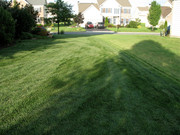
Here's the standard lawn shot. My apologies for catching my shadow in the image, I generally take these a bit earlier in the day.

I took a photo of the grass from the other side of the property to prove that I actually do work on that. Please note, this is one case where I adjusted the brightness of the photo to compensate for the camera's poor choice of exposure time. I really was trying to photograph the lawn, not the house across the street!
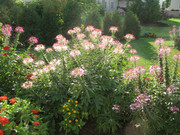
This is the more or less standard back garden shot. You can see it's matured even in the two weeks since the last set of photos!

This is roughly the same view, but taken from the other side to show off the central plants nobody ever gets to see in photos.

Standing on the patio during the evening affords some nice views out as well. There's a row of smaller plants in front of the cleome you don't see in this image, except for a stray volunteer Melampodium and the edges of some zinnia.
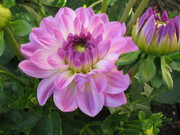
I divided my Sky Angel dahlia last year and the daughter plant is finally starting to bloom. This blossom is young yet and still has the tight center and green interior of an immature flower. Those turn to a pale lavender as the bud ages.
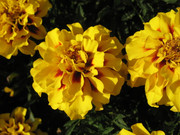
The Aurora marigold are doing well, but probably won't make the cut for next year. The plants are smaller than I prefer even if the blossoms are a perfect color.
Beginning Fall Feeding
And happy Solar Fall, which started on the fifth. I forgot about that!
Early to mid-August is the time to start organically feeding the lawn for fall. This gives the protein time to break down and begin to work, which generally takes around three weeks. I'll specify that this is for protein-based feeding only--synthetics can wait until Labor Day, and even Milorganite should be held until the third week of August.
For most of us in the Atlantic region, temperatures break cooler by the third week of August, making any time in the first three weeks of August the correct time to feed.
I went a bit early on July 28th. Now, not quite 2 weeks later, the lawn is going slightly insane. Colors have deepened, growth is accelerating, and spreading is filling in a few minor holes left over from spring. Our very high rate of rainfall doubtless has something to do with that, as do the moderate temperatures.
My personal plan is to feed again towards the end of August with Milorganite, followed by soybean meal in mid-September and again the second week of October. That pretty much closes the year for organic feeding as temperatures will drop quickly after that.
My final feeding will be whenever top growth stops on the lawn, usually around Thanksgiving, and I'll use a synthetic for that.
Tuesday, July 30, 2013
Late July Photos
The month has been fairly kind to the lawn and gardens, even with a solid week of 95°+ weather in there. Burn on the lawn is minimal, and the gardens responded by blooming more!
As always, you can embiggen any photo by clicking on it.
First, the general lawn shot:

And a general around-the-curve shot of the gardens. The cleome are doing very well, so well that I'm weeding them out and throwing them away. Colors are drifting a bit as the generations spin on, the ones here are a light pink and a rich pink respectively.

Here's the other garden curve in the back. The cleome here is a rich magenta, the ultimate goal on color throughout the garden, mixed in with lighter magenta and pink ones. Unfortunately, controlling the reproduction of cleome is nearly impossible, so I'll have to breed the colors by choosing parents to make sure that the hues are at least carried recessively.

If you noticed the large red shrub above, it's a crepe myrtle. Which is fairly amazing for Pennsylvania, actually. Crepe myrtle are more of a southern state plant, but I managed by putting this on life support for several years before planting it in a well-protected and warm microclime in the garden. This crepe myrtle is just about done with its first bloom, and I'll remove those front-hanging branches once it finishes up.

One of the test plants in the garden this year is an Easter Egg Plant, which is actually an ornamental eggplant. This one definitely passed the test and will be showing up in following years, although I'll probably move them to pots to show off the eggs better. At the moment the eggs are white, but they'll turn yellow through August and orange in September. That top egg isn't flawed, just a little dirty.

Monday, July 8, 2013
Encap Score! And Feeding...
Unfortunately, our local K-Mart store is closing, but fortunately they were having a store closing sale. I picked up enough Encap fast-acting lime (calcium carbonate) to apply the July liming to the lawn and gardens at 25% off.
I also drained their entire supply of K-Gro Plant Food, but that's another story, as is the rather attractive lacquer pot I bought.
While I was at it, I fed the gardens with 31 pounds per thousand square feet of Milorganite. That will supply 1.5 pounds of nitrogen per thousand square feet, slowly, and will release through mid-August at a fairly high rate. At that point, garden feedings tend to be more to restore the resources I've taken out this year, plus put some slow release nitrogen into the soil for the following year so the bulbs have something to eat.
Milorganite won't cause a massive growth flush, so you won't generally notice the effects immediately. However, over a month or so, plants become larger, darker green, and healthier than they would have been, and the advantages continue to mount if you keep using it.
Some nitrogen is released even a year later, so the feeding I did today will still benefit the garden well into next summer. And the organic material will stay behind, helping to aerate the soil, retain some extra water, and encourage bacteria and fungi.
Thursday, July 4, 2013
Fourth of July Lawn and Gardens
It's traditional for me to take photos on the Fourth of July to hallmark the unofficial "middle of summer" for the lawn and gardens. Please note, the actual middle of summer isn't until August fifth.
As always, you can click any image to embiggen it!
The lawn is doing very well this year due to the constant and very heavy rainfall we've experienced. I irrigated it exactly once, and then only enough to carry it through until the next rainfall arrived. The color is a touch pale, but that's normal for July and normal for heavily overcast conditions that have persisted for more than a month so far.

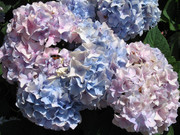
I managed to get the hydrangea to bloom mixed blue and pink with a note of purple this year, but that was mostly luck.
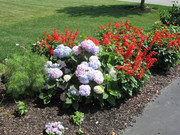
Overall, the gardens are doing tolerably well, but some things are delayed. The marigold and dahlia don't mind the weather, but the zinnia would prefer more sunlight.

Here are some closeup shots of a variety of flowers.
A dahlia with a visitor. This particular dahlia is slated to be tagged later on in the season and wintered over in the cellar.

This is another dahlia that's slated to be saved--as it turns out, most of the bi-color and multi-color ones are. The flowers on this look brighter in person, with brilliant cherry-red petals centered in a creamy white.

Here's a zinnia that's actually producing large, scarlet flowers--the color is more saturated than it looks in this photo.

Tuesday, June 11, 2013
A Bunny Bonanza
Either rabbit populations are very high this year (and they don't seem to be) or they particularly like eating Dreamland zinnia. In either case, none of mine in the back are growing all that well because they keep being eaten back to the stem.
OK, enough of that. When this happens, there are a few things you can try:
1) Fence the garden, if possible. Fencing should go down at least six inches below ground as rabbits are excellent diggers. This isn't a good solution for me as these are display flower gardens.
2) Trim your roses, use a machete or any other device to chop the thorny branches into small pieces, and scatter them in the areas where you have rabbit problems. Rabbits won't pick their way across thorns any more than you would. This is most useful in smaller areas, and isn't particularly attractive. However, if this continues, I'll try it.
3) Chop up anything pungent or hot and scatter it around the plants. I used three small handfuls of black pepper, chopped fairly rough, and scattered it around the zinnia.
4) Spray the plants with a repellant. There are plenty of homemade repellants, most involving a little dish soap, black pepper, cayenne pepper, and fresh garlic. Refresh this after rainfall.
5) Spray the plants with an over the counter repellant, like Liquid Fence. The effectiveness is variable, and it tends to be a bit on the spendy side.
6) Plant sacrificial plants at the edge of your garden for the rabbits to eat in the hope that they won't go after the others. It's not terribly effective and can attract rabbits to the edible plant(s).
7) Ignore it.
Saturday, June 1, 2013
That Lawn Thingy
If you noticed the previous series of photos, the lawn looks...very odd. For some reason, all the tips have gone brown, but the dead tips don't extend past about an eighth of an inch. Underneath that, the grass is green and growing.
This is actually a statement on what NOT to do with your lawn. Don't mow the day before an unseasonable frost. Then don't follow it up with a mow the day before the temperatures suddenly spike to a very unseasonable 92.
If you do, expect this to happen. While you can apply copious water to force further growth and then cut off the dead tips, I'm content to let nature take its course. The next time I mow, the grass will restore itself to the normal color and texture, with no harm done. It's best to wait until after a good rainfall and a resumption of normal temperatures to do this. Fortunately, large amounts of rain are expected tomorrow and Monday, followed by a much more normal early June.