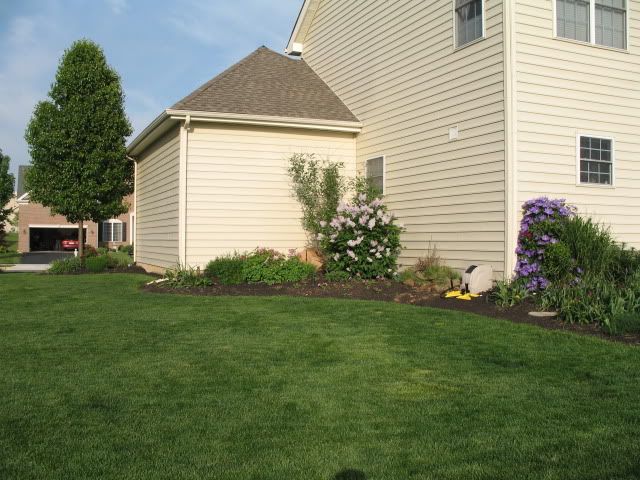
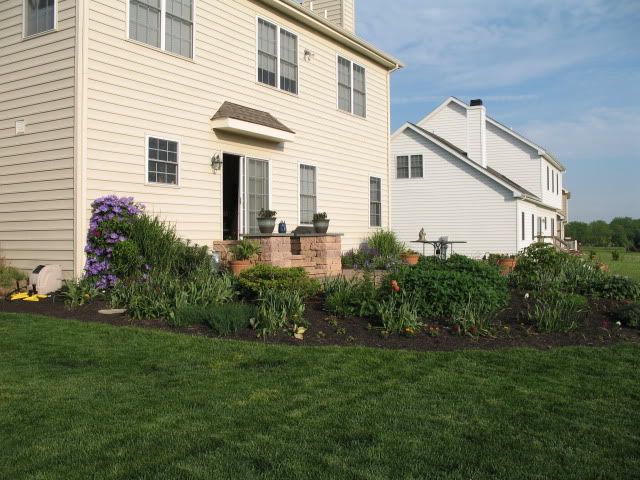
The iron has definitely kicked in, and the gardens are beginning to show some nice flowers.
This, after three years of organics, is very close to the lawn I want. I have some nutsedge to get rid of, but that's turning yellow and dying out now. Walking on this is like walking on a cushion.
As always, click to embiggen!
Friday, May 22, 2009
Photo Update!

Wednesday, May 13, 2009
More Milorganite and Ironite
I've just applied 4 more bags, 144 pounds, about 25 per thousand of Milorganite to the lawn. Additionally, I added another 4 bags, 160 lbs, of Ironite to continue to increase the iron levels. The grass is definitely less chlorotic and I'm hopeful that next years' soil test will show considerably improved iron levels.
I'm still working on the annuals, but I'm close to completion. I picked up a few heliotrope and Gerber daisies for pots, but I don't think I need anything else.
The Certainty application from earlier on the nutsedge is definitely working, although I may still patch some of the larger areas.
Sunday, May 10, 2009
Certainty on Quackgrass or Nutsedge
I have a little nutsedge (it could be quackgrass; it doesn't matter much), so I've sprayed those bits with Certainty at 0.75 ounces per acre equivalent.
I'm hoping that will knock it out. If not, I still have enough donor sod to repatch the entire area with plenty left over.
The annuals are now going in as well...ten flats worth. This year, I've used marigolds, salvia (red and blue), ageratum, dwarf snapdragon, rocket snapdragon, Orchid Madness petunia, star sapphire petunia, alyssum, Impatiens, Gazania, verbena, Melampodium, annual phlox, and cannas.
I'll take photos once they start to grow a bit. I won't finish until the middle of this week, I think.
Friday, May 8, 2009
Photo Update!
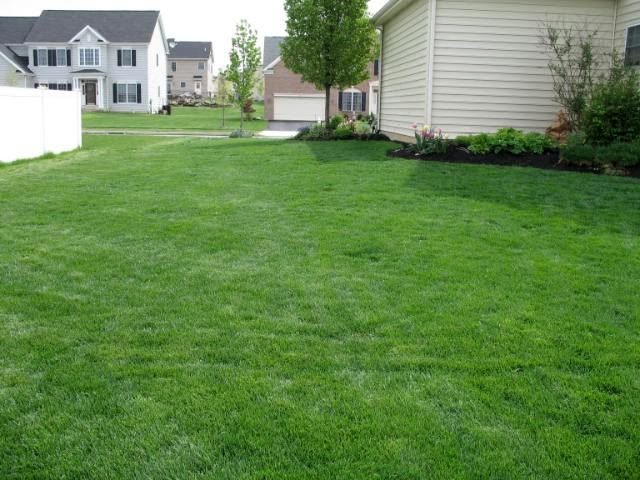
It's been some time since I updated the images. Here's the lawn as of yesterday. The color is a little chlorotic, but it's been raining for eight days. That will recover fairly quickly, and the last of the holes are filling in now.
As always, click to embiggen!
Thursday, April 30, 2009
More Milorganite and Ironite
I'd applied a considerable amount of iron last week and the color deepened, but the new growth is already becoming considerably lighter. With soil tests of 1.4 ppm iron, I'm not terribly surprised.
I applied another 72 pounds of Milorganite and 60 pounds of Ironite to get my iron levels up a little higher. It looks like I'll need to do that again in two weeks as the levels now should be measuring around 9 ppm which is still too low.
Thursday, April 23, 2009
Soil Test Results
The University of Massachusetts test results of my lawn soil are back:
pH: 7.2 (a touch high...3.2 point shift in 3 years)
Buffer pH; 7.1
N: 10 ppm (organic lawn)
P: 9 ppm (a bit low)
K: 321 ppm (off the charts)
Ca: 3185 ppm (way off the charts)
Mg: 269 ppm
Ca/Mg Ratio: 11.8 (thoroughly wrong)
Organic Matter: 4.6% (up from 0.1%)
CEC: 15.9 Meq/100g
Aluminum: 19 ppm
Boron: 0.4 ppm
Manganese: 7.0 ppm
Zinc: 1.8 ppm
Copper: 0.5 ppm
Iron: 1.4 ppm
Sulfur: 45.7 ppm
Soluble Salts: 0.26 dS/M (normal range 0.08 - 0.50)
Percent Base Saturation: K: 4.4, Mg: 11.7, Ca: 84.1 (Ca/Mg ratio here is 7.1, though)
Lead: Undetectable
The soil pH is OK given the amount of raw organic material I apply and it'll drift down in a year or two as I back off and the fungal mass drops. Kicking in a little P (phosphorus) is a good idea. Iron's very low, so Milorganite would be a good addition to get both iron and P. I should ignore any potassium sources for the remainder of the year as that's quite high.
A whisper of boron is a good idea, too, but not much.
I've applied 7 bags of Milorganite for iron and phosphorus, plus I broke down and put down 3 bags of Ironite (which I would rather not repeat but will probably have to). I also purchased 20 Mule Team Borax, diluted 1 teaspoon in 1 quart of water in my sprayer and applied that over 1,000 square feet of the lawn with around 20 gallons of water dilution on top of that. That should bounce the boron levels a touch.
Sunday, April 19, 2009
Photo Update!

As always, click to embiggen any photo.
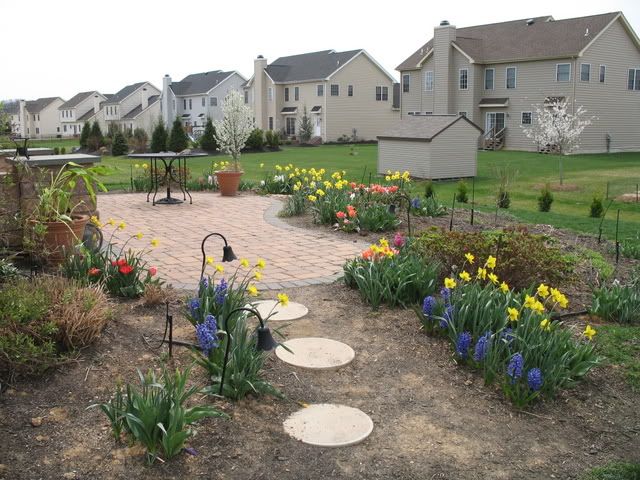
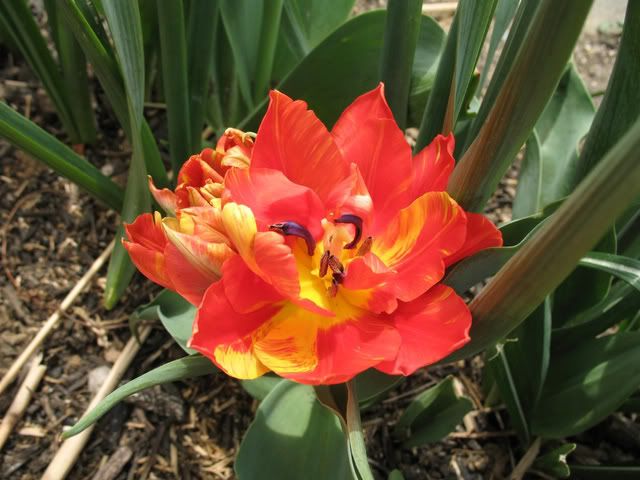
Bonus shots! Here's the back garden, plus two closeups:

Tuesday, April 14, 2009
Fifteen Thuja standishii x plicata (Green Giant Thuja)
We'd like a bit more privacy on the back line, plus something that will stay evergreen and give a bit of wind protection. Thuja standishii x plicata, Thuja Green Giant, fit that bill perfectly. Our local nursery, Glenmar, promised 2 gallon, 2 foot plants. We got 2 gallon, 3 foot or taller plants, so I'm very pleased and the price was extremely reasonable at around $27 per shrub. Glenmar always has incredibly healthy plants and the prices are good.
Fifteen of those are now on the back line, one every five feet for a faster privacy screen and to limit their adult height and width. They shouldn't go taller than 20 feet, whereas a single specimen can get very wide and 40 feet tall.
For soil preparation, I used six small handfulls of corn meal mixed with a bit of alfalfa and a small amount of kelp meal in around thirty cubic feet of soil (per plant). That was mixed in to the soil and the holes were dug about 2' away from the bushes to give them a clear field with no competition. I didn't dig any deeper than the root mass to give them a solid base.
Advertising says they grow three to five feet per year, but that tends to be once they're established. Starting at 3 feet, I don't expect much more than six inches of growth this year, 18" next year, and then they should begin to grow quickly.
If you have questions about Thuja, visit the Bestlawn forum and use the Around the Yard section. You can sign up for free, and they have people who know a lot more than I do.
Sunday, April 5, 2009
Certainty on P. annua (Annual Bluegrass) and More
I sprayed Certainty at the recommended rate of 0.75 ounces per acre (although I spot-sprayed) on some P. annua (annual bluegrass) in the lawn. We'll see how that works--I'd rather not take out the patches with Round Up as they're very small and mixed in with the rest of the bluegrass.
I also applied 150 pounds of soybean meal to the lawn today, for about 1.5 lbs of N per thousand, 0.2 lbs of P, and 0.4 lbs of K. This will probably be the only feeding in April, and this won't be available to the lawn until April 25th or so.
Wednesday, April 1, 2009
Does Corn Meal On The Lawn Really Work?
I found this search term in my logs and I was intrigued by the question. The short answer is: yes.
The longer answer is that it depends on what you're doing.
For fungal control, 10 to 20 pounds per thousand square feet are sufficient. Corn meal attracts trichoderma fungus, This fungus takes up space in the soil, giving your invading fungus less room to grow. It also has the ability to kill other fungi, which is a major advantage when fighting a fungus problem in your lawn. However, for severe infections chemical controls may be called for.
For soil conditioning, anything from 10 to about 60 pounds per thousand is fine. Your worms like to eat fungi and bacteria, and the corn meal will grow those in spades. Additionally, bacteria and fungi themselves help condition your soil by attaching soil particles together using glomalin, increasing the soil's structure.
For feeding the lawn I wouldn't use corn meal. Granted, organics don't feed the lawn directly, however there are higher protein (nitrogen) meals available such as soybean that don't require the amounts that corn meal does. Additionally, corn meal doesn't contain large amounts of phosphorous or potassium, making it a less effective fertilizer overall. Sixty pounds of corn meal per thousand square feet would be required four times yearly to feed the lawn. By comparison, fourteen pounds per thousand square feet of soybean meal four times a year will feed the lawn at the same level.
For smaller fungal outbreaks you can use the corn meal from the grocery store. For general soil additives, purchasing the corn meal from your local feed mill is far more cost-effective.
Cracked corn will work just as well, although you may notice birds feeding on it.
We discuss a lot of these issues over at Bestlawn and you can read all the forums without signing up. However, signup is free, they never send unrequested e-mail, and everybody is very helpful with lawn questions.
Tuesday, March 31, 2009
Another Photo!
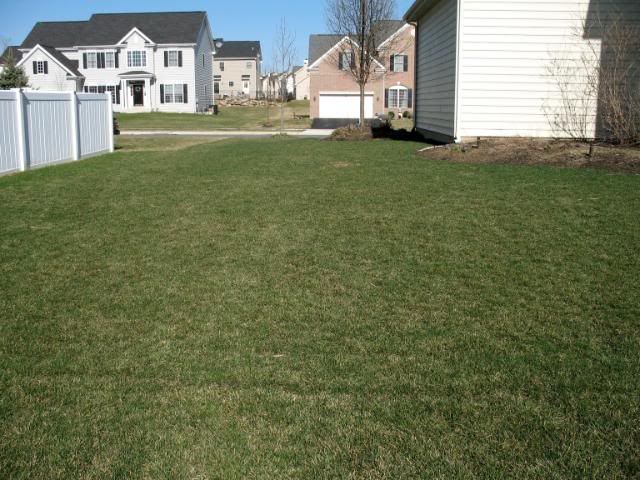
As always, click to embiggen. This shot is from today, March 31, 2009. The color is starting to deepen and the density is slowly increasing. If you look very closely, you'll see a few minor problem areas that I've now core aerated. I'd already reseeded those over the winter and they should be sprouting sometime soon.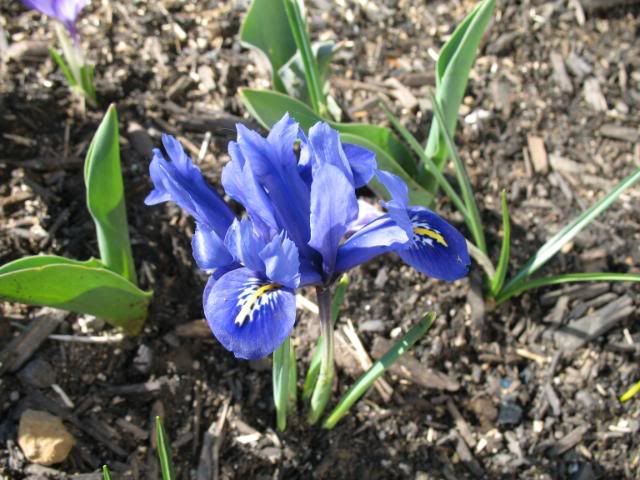
Sunday, March 29, 2009
Soil Testing
I'm sending off soil tests to U. Mass Amherst, but I also have a small and very basic sample kit of my own from Rapid Test.
The pH tested at 6.5 (see below), and I'm pending on the other tests waiting for the soil mix to settle. That could be 24 hours, so I'll update this later. (Later: N is testing as deficient, which is no surprise on an organic lawn. P tests as sufficient. K is testing as surplus).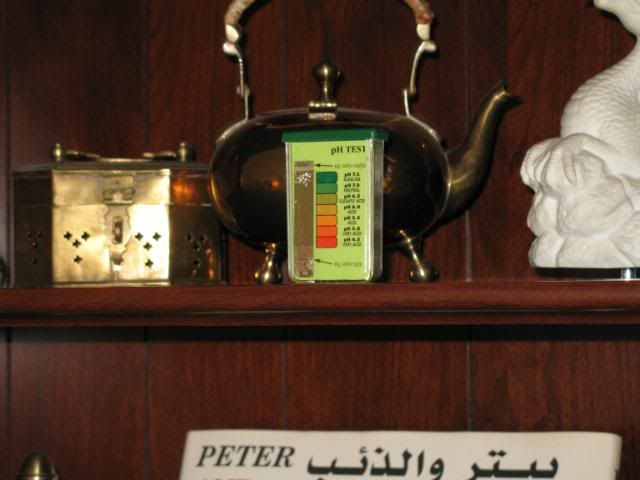

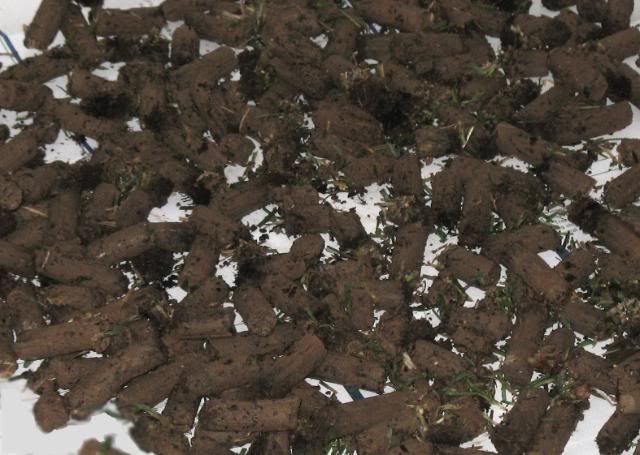 And here are the soil cores for U. Mass Amherst.
Friday, March 27, 2009
Kelp on the Lawn and Gardens
I just put down 10 pounds per thousand square feet of kelp meal on the lawn and gardens. Using a standard of 1-0-2, that's around 0.1 lbs nitrogen, no phosphorus, and 0.2 lbs of potassium. However, kelp generally isn't used for its NPK supply and functions far better as a soil conditioner.
Kelp contains auxins, cytokinins, and gibberelins, which encourage the roots to grow as well. That will help in both the lawn and gardens and assist in restoring more of the grub damage they sustained last fall.
Saturday, March 21, 2009
More Corn Meal
I bought 7 more bags of corn meal, six for the lawn and 1 for the gardens. That went down today.
One note that I have is not to purchase the fine-ground stuff in the future. I had to put that down by hand, whereas the rougher ground will go through my spreader. Doing it by hand took four hours.
Well, at least it's complete! That's now 83 pounds of corn meal per thousand (about eight times normal), or enough to condition the soil through spring. If I add any in May, I'll probably go with cracked corn. Right now, I have some very happy earthworms who will hopefully have more earthworms...
Tuesday, March 17, 2009
Corn Meal and the Lawn
200 pounds of corn meal went down today, and I'm starting to account for the area that will end up being planted with Thuja come April. As of now, I'm using a typical standard of 6,000 square feet of lawn, figuring that about 1,000 will either be under or behind the new bushes and I won't want to feed it because I don't want it to grow that much.
So that works out to 33.3 pounds per thousand, about half what I'd like to add (but I could only get 4 bags and will need to go for four more). Corn meal is mostly a soil conditioner, or used to combat fungal issues, which I don't have. I'm looking to deepen the topsoil more, however, and for that it works well and can be put down in very large amounts as it has few resources. I use a standard NPK of 1.65-0.65-0.40 for that, a far cry from soybean's 7-1-2.
Subscribe to:
Posts (Atom)