We're pretty much at peak on the gardens for the year, although things are still a bit delayed and I'm expecting a good show right through September.
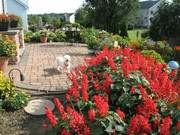
The salvia always do well, and our older dog appreciates that.
I like the Babylon dahlia, although I wish they were a bit taller.
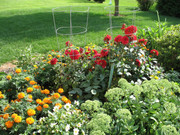
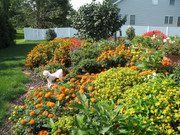
The general garden image, along with our younger dog.
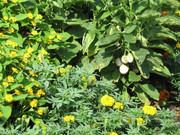
Easter Egg plant are a fun addition to any garden. Right now, the "eggs" are white, but they'll mature to yellow, then gold, and finally orange in September and October.
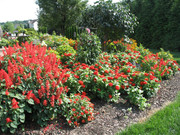
The northern face of the back garden. It's very red this year...
Sunday, August 12, 2018
Mid-August Photos

Wednesday, July 25, 2018
Late July Photos
We've had about three inches of rain since Sunday, which has restored the grass and pushed the gardens into growth. At this point, they're pretty much caught up with late July and look pretty good.
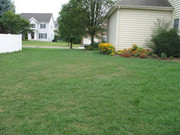
The grass is definitely recovering, but still shows signs of the drought it was in through June and into July. Regardless, it'll recover fully by fall (assuming rainfall) and no harm done.
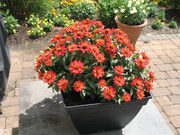
The Profusion scarlet zinnia are doing incredibly well. They're redder in person, and this one is a bit more orange due to all the reflected light off the house.

The northward view of the back garden is maturing nicely. I lost a plant in that hole, but it doesn't look too bad.
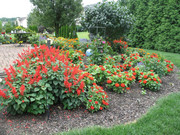
Standing on the river stone drainage area, there's a distinct orange path of flowers.
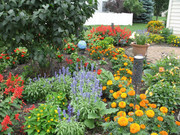
The southern side of the back garden is a bit spottier, but still doing pretty well.
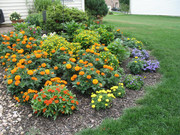
The zinnia is a volunteer crossbreed between yellow and orange. So far, it's breeding relatively true.
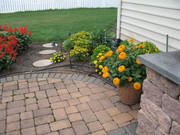
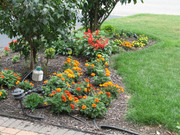
The front garden is a bit more constrained and less frenetic, but I still enjoy a lot of color and life out there as well!
Friday, July 20, 2018
More July Photos
Things are moving along, although slowly. While I just posted images a few days ago, I took several this afternoon that are worth showing off.
Profusion scarlet zinnia are new to the garden this year, but very quickly earned an established place for future years. They're much redder than the Fire, although not quite a scarlet except in more shadowed areas. And they are, indeed, profuse.
The dwarf dahlia (purple/white and white) are finally moving along a bit, although not nearly as full and heavily blooming as they would normally be.
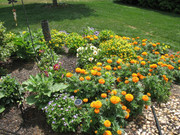
The black-eyed Susans are starting, while the rest of the garden is still gearing up. Normally, this would be approaching peak, but that looks like it'll be very late this year.
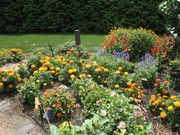
Wednesday, July 18, 2018
Mid-July Photos
The lawn has improved a bit as rainfall resumed on July 4th, although it remains dry. The next week or two looks to be somewhat wetter, fortunately.
The gardens are still behind where they should be, which would be approaching peak in a normal year. This year, peak won't be until mid-August.
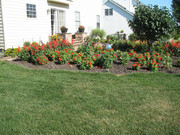
It looks OK from the top of the deck.
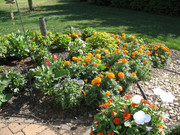
Although generally small, individual Magellan scarlet zinnia are doing very well.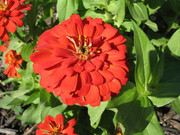
The red Profusion zinnia are doing extremely well! They're still small, but very colorful.

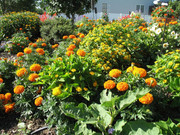
And from the bottom of the bed, the garden is a bit haphazard, but pretty.
Monday, June 25, 2018
Late June Photos
Even with no rain (or, perhaps because of the increased sunlight and adequate water via irrigation), the gardens have taken off. While the Fourth of July is the traditional day for photos for the real start of summer, I took a bunch this evening.
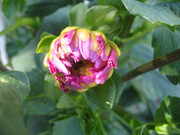
A lot of the dahlia bulbs are second-year, so they're blooming much earlier. This Blue Boy normally wouldn't blossom until late July.
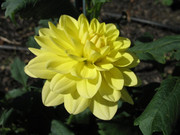
The same is true of the Sun Lady dahlia. These highlighter-yellow bloomers are some of my favorites!
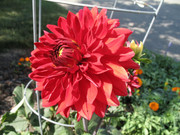
The Babylon Red dahlia is new this year. Although supposedly a late-season bloomer, these are doing very well in late June. The flowers are pretty large and even redder than they look in these images.
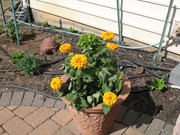
The gene-mixed yellow/orange zinnia bred relatively true, so I'll be saving more of these for next year. They're a nice tangerine color.

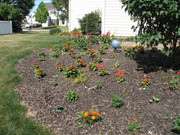
The northwest face of the garden. It's a little spotty, and I just transplanted Melampodium and Easter Egg plant into the areas well, but the zinnia are starting to look nice.
This is one of the parent plants for that orange/yellow zinnia.
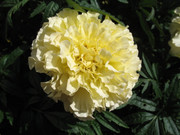
I really like the French Vanilla "white" marigolds. They were perfect last year, they're a hit again this year.
Saturday, June 23, 2018
No Rain
We're getting rainfall in occasional drips and drops, but nothing appreciable. The grass is starting to go dormant, although I'm maintaining the gardens, of course.
You can water, about an inch a week total on most northern (and most southern, for that matter) lawns, done either all at once, once a week, or half the amount twice a week. Mow as long as you can tolerate the lawn to preserve water, and try to mow very early in the morning or just before sunset to minimize water lost to bleeding.
If you'd rather not water, that's fine for northern lawns, at least. Bluegrass will go dormant and incidental rainfall is usually more than enough to keep the roots alive. Rye and fescue will stop growing and are tolerant of weeks of little to no rain, although they have no dormancy mechanism as such. For southern lawns, Bermuda will go dormant and the mechanism is at least as good as bluegrass'.
If you see the dry spell coming, stop mowing. Even if the lawn is a little long, don't mow it. Longer grasses use less water, and shade their soil better, slowing evaporation of the water that remains.
Try to minimize the wear on the lawn during the drought. Normal usage isn't a problem, but a game of football might not be the best idea. Grasses that aren't quite fully dormant will take damage, as will fescue and rye that can't go fully dormant.
Don't feed. That's a good summer rule to begin with, but skip even the organics.
And other than that, don't worry too much. Grasses can tolerate a summer drought just fine and, worst-case, you may have to reseed in some places in very early fall.
Monday, June 11, 2018
Images Down
PostImage has had some problems lately and has changed their domain. As time wears on, I'll work a bit on restoring old posts--but not very hard or very much.
Things Are Really Underway...
I got distracted by any number of things and could either do the work or talk about the work. I did the work. :-)
The lawn's been fed (soybean, as always) as of May 1, and the gardens were planted shortly thereafter, once I was sure all chance of frost is past. Rain's been relatively consistent, with just a short June dry spell so far that had no real consequences.
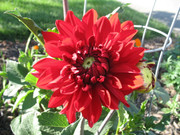
The Babylon Red dahlia are doing extremely well. I hadn't expected them to blossom this early!
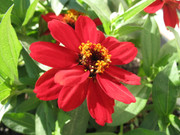
A new addition this year, the scarlet Profusion zinnia look like they're going to be incredible.
Saturday, March 10, 2018
Things are Underway
I haven't blogged because I've mostly covered things in previous years. I'm moving dates around a little bit, so the blue and red salvia are both starting later this year. They were crowding each other out a bit.
I moved the ageratum earlier as it had a very slow development last year. This year, it's already starting to get rootbound with 2 months left to go before planting. I'll pinch them back if I have to and they'll be just fine.
I took a few photos of the setup downstairs. Again, click on any image to embiggen it.
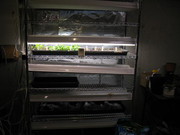
This is the sprouting area in my home office. The red/white light is a set of 12 volt, total of 12 watt, LED strips I cobbled together and mounted on flexible vinyl. I use that to illuminate my wintered-over flowers as well as to help new plants sprout.

Only one deck is currently in use downstairs, out of six. The second will come online sometime late next week, probably. After that, it moves fast. We're currently 8 weeks out from last frost. On the left are Easter Egg plant and ageratum. The right is the newly-sprouted heliotrope (which is not going well) and the blue salvia (which is just small and will be fine).
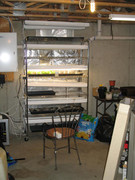
This is a wider view, also showing my very messy working area. My better half won't come downstairs until I clean all this up, so we're talking May.
Saturday, February 3, 2018
The Cycle Starts Anew
Yesterday, Groundhog's Day, marks six weeks until the official Spring Equinox...and about 12 weeks until the annuals are planted.
It's time to start the seeds that require the longest development time, like vinca, ageratum, heliotrope, and the like. I started the first set (vinca, ageratum, and heliotrope) last week, with the heliotrope continuing on the heater this week with the Easter Egg plant.
The heliotrope, so far, has 5 of 24 plants sprouted, but typically takes a long time and has a very low germination rate. I put dozens of seeds in each cell.
Tuesday, December 26, 2017
2017 Lawn Additions
This year's heavy hitter was soybean meal, as usual, with some corn early in the season. Even with the heavy rains, fungal issues never occurred.
I did spray ferrous sulfate as well, which helps enhance the color, back right around the time I winterized.
2017 was very similar to 2016, and I expect no major revisions for 2018.
| Date | N | P | K | Iron | Organics | Other Notes |
| 5/1/2017 | 1.22 | 0.37 | 0.19 | 0.00 | 25.0 | Soybean Meal, Cracked Corn |
| 8/1/2017 | 0.93 | 0.26 | 0.13 | 0.00 | 13.3 | Soybean Meal |
| 9/1/2017 | 1.12 | 0.32 | 0.16 | 0.00 | 16.0 | Soybean Meal |
| 10/1/2017 | 1.10 | 0.31 | 0.16 | 0.00 | 15.7 | Soybean Meal, Urea |
| 11/14/2017 | 1.14 | 0.00 | 0.00 | 0.00 | 0.0 | Urea |
| Total per K ft: | 5.51 | 1.27 | 0.54 | 0.00 | 70.0 | 70.0 active organic total |
2017 Garden Additions
2017 is almost a carbon copy of 2016's garden applications, with levels more than sufficient to sustain a dense flower garden. As the photos show, I certainly had no problems with blooming intensity!
About the only change was a reduction in the amount of monoammonium phosphate. Phosphorous levels are already very high.
I didn't list the slow calcium I added this year, about 20 pounds per thousand square feet. That will gently release over the next few years, holding the pH in the lower 6 range.
| Date | N | P | K | Iron | Organics | Other Notes |
| 4/9/2017 | 0.11 | 0.52 | 0.00 | 0.00 | 0.00 | Monoammonium Phosphate |
| 5/12/2017 | 1.32 | 0.30 | 0.25 | 0.36 | 21.5 | Milorganite, Soybean Meal |
| 6/1/2017 | 1.32 | 0.30 | 0.25 | 0.36 | 21.5 | Milorganite, Soybean Meal |
| 7/1/2017 | 1.32 | 0.30 | 0.25 | 0.36 | 21.5 | Milorganite, Soybean Meal |
| 8/1/2017 | 1.32 | 0.30 | 0.25 | 0.36 | 21.5 | Milorganite, Soybean Meal |
| Total per K ft: | 5.56 | 2.50 | 1.00 | 1.44 | 86.0 | 172.0 active organic total |
Monday, October 16, 2017
The Last Night
First frost is expected this evening, although it's possible that we might miss it. In that case, frost won't be expected until very late October.
Still, even a near miss will damage or kill some of the gardens. Some has already gotten old and died, some don't respond well to temperatures under 45°. I've pulled out and composted about a quarter of the gardens at this point.
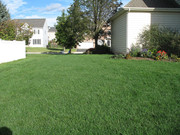
First, the standard shot. As always, click to embiggen it. Although we had a short drought, the grass came through just fine and has attained its October dark green.
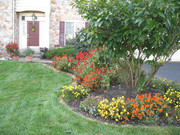
The front gardens are doing fairly well.
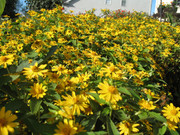
Whether we get frost or just very cold, the Melampodium won't ilke it and will probably die tonight. They don't much like temperatures below fifty and they're extremely unhappy at 45.
The dahlia are still doing pretty well. Here's a Jennifer's Wedding dahlia, probably on its last night. I cut off all the fresh blossoms just after photographing this and put them in vases indoors, where I can get three or four extra days out of them.

Wednesday, September 20, 2017
Late September, Spinning Down
It's not noticeable unless you know the gardens very well, but they're starting to slow down and come to the end of the season. Some plants I'm letting seed out at this point. Plus I need to deadhead again, which is a huge job at the end of the season as the flowers don't last nearly as long.
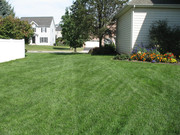
Here's the standard grass photo. As always, click on any image to embiggen it.
And the standard garden shot, showing the northwest edge of the gardens.
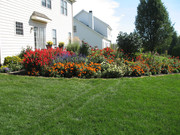
While still bright and colorful, plants are now a bit harder to control, and the bud production is slowing as the days get rapidly shorter.
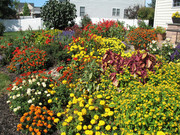
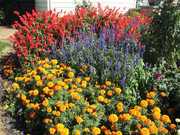
They're still impressive, but even the marigolds are sporting smaller blossoms. The blue and red salvia aren't showing any seasonal changes as of yet, but that's coming.
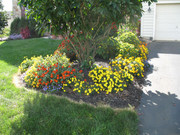
I've imposed the garden edge for the fall so the grass is a touch brown around the gardens. That'll go away the next time the gardens are edged. Still, the front edge under the fringe tree looks pretty good!
Monday, September 4, 2017
Labor Day Photos
While the gardens are moving past peak, the lawn is just coming into its own as of today. It'll continue to improve through late October before starting to stall for winter. As always, click on any image to embiggen it.
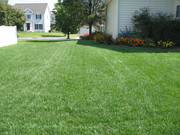
The standard lawn shot:
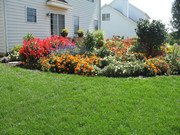
And the standard garden shot. No real fading is visible here yet, but things are starting to get a little leggy and weaker as the sunlight fades.
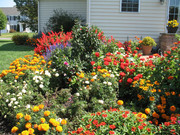
Here's a closeup from the center of that shot, facing the house. Again, you can see the over-growth and the fact that I have to work much harder to keep up with the dead-heading.
Individual flowers are still doing very well, of course. This is a Magellan scarlet zinnia, one of my favorites.

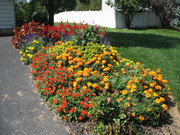
The front garden is doing well. This is the section north of the driveway, but I'm also more careful here since this is visible from the street and to all the surrounding neighbors.
Subscribe to:
Posts (Atom)