So far, the plants have successfully tolerated nights as cold as 40°, pouring rain, fairly high winds, and bright sun in warm weather. While a few of the flats are mildly sunburned, it's nothing significant.
At this point, I've pulled them out a few feet to see more sunlight. The weather forecast has changed and tonight's weather will be warm enough to leave them outside.
Unfortunately, it looks like we may have a slight risk of frost next week (the week of the 12th), so I'll hold off planting. Generally, planting starts early as soon as I'm certain the forecast is clear of cold weather.
I have two pots in my office that I did plant, with a dahlia and a red salvia. Those can stay indoors as long as possible, and they're on a sunny windowsill. While stressful, the plants shouldn't have an issue with a week or so in that location.
Sunday, May 4, 2014
Hardening Off Continues

Monday, April 28, 2014
Hardening Off
Hardening off begins today as we're expecting several days of decent temperatures and cloudy, rainy weather. The plants are now outside enjoying a bit of sunlight and 70 degree weather as the clouds roll in.
I tend to try to choose a cloudy period as it's easier to adjust the plants to light if they don't need to adjust to full sun immediately. Even through a high cloud layer and putting them out late day, today's sunlight is enough to make them wilt a little bit.
As always, you can click on the image to embiggen it. In the larger version, the tall salvia in the back and the marigolds in the front are just a bit wilted. They'll recover as soon as the sun is off of them.
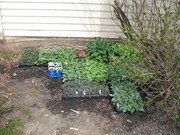
I'll bring them back in next Sunday when the weather turns colder again. They'll have three days to recover before going back out, and that will be very close to the proper time to plant.
The Cleveland pear tree is doing well this year. The tree below is now 8 years old and started as a 3' whip, but I've been encouraging it.
Again, click to embiggen.
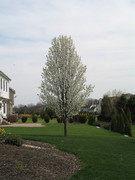
The grass came roaring back post our very hard winter. As of this point, I haven't fed it yet, it doesn't require feeding until mid-May at the earliest.
As always...well, click it. You know the drill. The dead tree lying there is what remains of the Hinoki cypress I cut down over the weekend. I've already removed a fair chunk of the sticks and twigs, and chopped part of the trunks off. I'll have that cleaned up long before the gardens get planted.

Saturday, April 26, 2014
Replacing the Hinoki Cypress
Our Hinoki cypress was unseated and tossed around by Hurricane Sandy back in October 2012. I knew the chances weren't good as the root systems were badly broken, but I reseated the tree and stanchioned it into place.
It did manage to survive until this winter, when the tree finally gave up.
Fortunately, I have a lilac I've kept dwarfed in another part of the garden that, frankly, really shouldn't be there. So today we dug up the cypress and replaced it with the lilac, which won't object to the transplanting and will enjoy that location just as much as it enjoyed its other one. It has the advantage that I don't have to dwarf it in its new home as well.
While transplanting, the root systems split into four, each with their own canes. Two bushes are now planted in other areas of the garden where they can also grow freely. And one went back into the location that the old bush came out of...oh well, I'll just dwarf it!
Transplanting a lilac is easy. Dig it up, take as much root mass as possible, and cut the canes back so they don't stress the roots too much. Place in new location, plant exactly as deeply as the place where it came out of, and water thoroughly post-transplant to settle the soil. In my case, I used a light mix of Miracle Gro to encourage the roots to grow back more quickly.
Lilacs strongly prefer near-neutral soil with good drainage and a high percentage of organic material. The organic material can be lower, however, and still grow a great lilac. They do demand at least 6 hours of sun per day (more is better) to bloom profusely.
Transplanted lilacs may bloom the next year if mature enough and if the root system you transplanted was large. Whips and suckers that are transplanted may need four to five years to bloom.
Friday, April 25, 2014
Holding Cold
Our average last frost date is April 20th, with the normal outside date May 15th.
This year, we look like we'll be receiving regular frosts and even a few light freezes through May 8th at the minimum, although the forecast that far out is unreliable at best. This could change at a moment's notice.
Still, I have plants downstairs that are starting to grow into the rafters (literally, the top shelf's lights are hung from the rafters, and the plants are now past the lights. The cleome and red salvia are particularly large, and so pot-bound in their little cells that they're starting to crawl out of them.
When this happens to you--and it probably will at some point--cease feeding and supply only water. You can also start the hardening off process under the lights at home.
First, put a fan on the plants to make the leaves and stems move. Shift the fan regularly to put it full strength on different flats. This will thicken the cuticles and stems, and train them to withstand winds. Although you can only get a ten to fifteen mile an hour equivalent wind on them, this will be sufficient to begin hardening them for outside life.
Second, run your hands over the top of the plants lightly once per day. Similarly, this will strengthen stems and leaves to withstand wind and other mechanical forces. It will also slow growth slightly as energy goes to thickening the skin and stem of the plant.
Third, let the plants wilt a bit before watering. This also strengthens the skin of the plant.
There's no substitute for sunlight and the plants will still need hardening off to the full light of the sun and the ultraviolet they haven't seen before. However, at the very least you can accomplish some of the hardening before you put the plants outside.
Tuesday, April 15, 2014
839
That was the final count on sprouted plants this year. While not a catchy number, it does mean I won't need much of anything from the local nursery this year.
Just for idle fun, here are approximate counts by species:
Zinnia: 370
Marigold: 180
Salvia farinacea: 75
Salvia splendens: 75
Celosia: 50
Cleome: 25
Easter Eggplant: 25
Melampodium: 25
Dahlia: 18
Saturday, April 12, 2014
Feeding the Thuja
I actually fed them late day Friday just before the showers came through.
Right now, this early in the season, I'm taking the easy way out. There's enough to do in the gardens that I don't have a vast amount of time to spend on smaller tasks.
So I wimped out and used some leftover 29-0-4 Vigoro fertilizer I had lying around. One small handful got thrown into the center of the bush to patter down and spread itself, while I spread more through where I know the roots go.
Since I was throwing things around anyway, I used about half Milorganite, half synthetic fertilizer to give a more sustained feed and add more iron to the mix.
Right now, the bushes are around 10-12 feet tall with a 5' diameter or so. Each bush received around 1/3 of a pound of 29-0-4, and 1/3 of a pound of Milorganite. The total instantly available nitrogen was approximately 0.1 pounds, with another 0.02 pounds of slowly available nitrogen.
I'll feed again in approximately two weeks, the fast way again. Once the gardens are in, I'll tend to use more Miracle Gro and Milorganite and table the 29-0-4 for the rest of the season. Feeding of the Thuja will continue through mid-August, at which point I stop to allow the bushes time to harden the new growth for winter.
Milk on the Lawn
Spring was delayed, but came on like gangbusters this year. It's currently around 70° F out there and absolutely perfect.
I spent most of the day putting down a bit over 1 tablespoon per thousand square feet of Prodiamine (Barricade), which will tend to deter weed sprout in the lawn and gardens for the next six months or so. I also treated the back patio and front walk to keep weeds from growing between the bricks. Effectiveness of the product is extremely good.
I washed that in with a gallon of milk spread over the lawn and gardens (the brick patio and walkway didn't get this, of course!), for about 8 ounces of milk per thousand. To that, I added around 4 ounces of humic acid and about 2 ounces of dissolved sodium laureth sulfate as a soil conditioner.
The sodium laureth sulfate helps soil bits conglomerate together instead of forming large plaques, increasing water penetration over time. The humic acid feeds the fungi in the lawn a little bit, assisting in water supply, nutrient supply, and general health.
The milk is...odd. It's not something I'd suggest adding unless your soil is tested and tuned fairly well, but it does seem to assist growth a little bit over a very long period of time. My idle guess is that an enzyme in there is similar enough to plant enzymes to unlock phosphorus from the soil matrix. But that's only a guess.
Over the next month, the milk will increasingly make the lawn a little greener, grow a little more strongly, and generally improve the look and durability. That advantage will maintain itself for the rest of the season.
Thursday, April 10, 2014
Too Late To Seed Now
As of today (which around here means plants will be put into the garden in around a month), it's now too late to start anything. If you didn't get there yet, you'll need to wait until next year to grow from seed.
The last of my plants went from the heater to the lights yesterday, and those were only 30 marigolds and zinnia that don't require much time. From here on out, I keep things watered, keep the lights on, and wait until they go out for hardening off around May fifth or so (give or take a few days).
While you could theoretically sneak in smaller, faster-developing marigolds like Janie or Durango if you plant immediately, they'll be very small when they go into your garden. That's not necessarily a disadvantage, although full growth and blooming will both be delayed.
Similarly, this is the wrong moment to seed your lawn (or feed it, for that matter). As of now, the new sprouts won't have time to develop good root systems before summer's heat hits. Feeding now simply taps the limited remaining carbohydrates from the grass roots and gives you lush growth--that won't survive the summer, and with tapped-out roots, there's no way for the plant to sustain the growth.
April is really a month to clean up, enjoy the blooming garden bulbs, and wait for the season to advance a bit. For me, garden planting will be around May 15th, with the lawn's first feeding following after the gardens have been planted.
Wednesday, April 9, 2014
More April Photos
While the planet just experienced its hottest month ever in January 2014, I was locked under a southern excursion of the polar vortex. That was unpleasant, but does have some positive side effects.
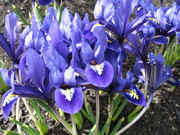
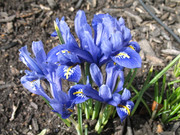
The Siberian iris, which have been limping along for years, actually got cold enough to fully set blossom. This year's blooms are fully colored, full-sized, and very pretty!
The photos below are close-ups, the actual plants are only about four to five inches tall total.
The purple iris (click to zoom in on the petal details):
The blue iris (ditto, the image is zoomable):
Thursday, April 3, 2014
April Lawn Photos
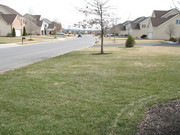
The snow has melted, and temperatures shot from the forties to the sixties pretty quickly. While the lawn definitely took a beating this winter, it should begin to recover shortly. Last year at this time we already had a fully green, growing lawn, this year growth hasn't resumed just yet. Soil temperatures are still a bit too cool for that.
You can see several patches of snow mold, which is unsurprising as the lawn spent most of the winter under snow and piles of snow from shoveling. This particular species of snow mold is pretty harmless, and the grass will recover with no issues. Those patches will simply be a bit slower.
As always, click on any image to embiggen it.
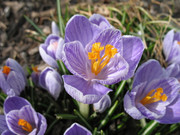
Bonus pic! The snow crocus just started to bloom as well, with this patch opening today. I missed capturing a native bee visiting the blooms by a few seconds. Again, these would normally blossom in early to mid March, but everything is late this year.
Click this one to embiggen and show off the stripes on the flowers!
Thursday, March 27, 2014
The Start of the Season
Well...sort of! Our temperatures are set to rise into the high fifties and sixties this weekend and onward (more or less May in April...again this year). I gave the Thuja and trees a light feeding since their roots are already awake (and in the Thuja's case, they're green and starting to perk up for spring).
In this case, I used some leftover Vigoro 29-0-4 mixed with quite a bit of Milorganite to give both a quick spike of nitrogen and an extended feeding through April.
I also purchased two packets of seeds--Mammoth sunflowers, the monsters that reach 15', and Chianti sunflowers, which grow to about 5' tall and bloom dark red. While Chianti sunflowers are poor performers compared to some other varieties, they should do well enough for where I want them. It's not a location connected to the main gardens.
Wednesday, March 26, 2014
Nearing the End Game
If you've been following along, you might remember that I miscalculated my number of plants by 1 flat. I ordered some Harlequin dahlia and Janie Flame marigold to fill that in, and I still have about a third of a flat of scarlet zinnia to go in there as well. Those haven't arrived, but should be here late this week or early next week, or in plenty of time.
The last of the current marigolds, Janie yellow and Janie orange, are sprouting now and almost ready to go downstairs under the lights. Everything else is already growing away down there, and the Easter Eggplant are actually getting fairly large.
I'm idly considering purchasing some red sunflower from my local grocery and cup starting those. Although tall, and not as long-season as I'd like, they might make an interesting accent in a few locations.
I did try some China Town celosia this year, and they sprouted well but didn't transfer to the four leaf stage very effectively. I'll have about half a flat opening up shortly when I transplant those into contiguous cells. I do have plenty of leftover seeds, ten of this, eight of that, to fill in.
Saturday, March 15, 2014
All Plants Start Now
Today marks 8 weeks until the end of frost, so for people in my gardening zone you can plant any seed you have. There's pretty much nothing that will overgrow the planting cells in that amount of time.
Except sunflower. Those you may wish to start in cups as they grow very quickly and dislike being transplanted.
As of today, the first of the Magellan zinnia started. Post this, I'll be planting marigolds, which fortunately don't require the full eight weeks (but do benefit from as much time as you can give them, so I'll shoot for six weeks or more).
Right now, there are six flats under the lights, two in my office sprouting, and four to go. At some point, probably early next week, I'll add a third to my office sprouting and perhaps a fourth.
Seeds that required longer periods should already be well-sprouted and into the four leaf stage. At that point, you can (very gently) feed them if you wish to. I fed very, very lightly today, 1/2 tsp of Miracle Gro in 2 gallons of water.
Tuesday, March 11, 2014
The First Zinnia
Technically, the first of the smaller zinnia. I'd started the Park's Deep Red and Envy zinnia at the beginning of the month. Both are now under the lights downstairs and the third rack of lights is now on.
As of today, I started the Persian Carpet zinnia as well as the Profusion zinnia (yellow, orange, and fire). While it's still a bit early and these will be extremely well-developed by the time they're ready to plant out, I don't have much choice.
Since I start 12 flats of plants, I have a limited time period to get everything started. This is now the sixth flat complete and either already sprouted and growing or on the heater and working on sprouting. That leaves six more flats to plant, sprout, and grow before early May.
So while I'm forced to start my smaller plants early, you still have some time. Short zinnia and marigold will do fine with four to six weeks before planting date. Eight to nine weeks simply gives them time to get very, very large (but conversely more difficult to adjust to life outside).
Next up, the Janie marigolds.
Wednesday, March 5, 2014
Most Plants Start Now
Plants that only take a very short time to grow, such as shorter zinnia and marigold, can be held and started as late as April first, but there's no disadvantage if you start these now as well.
Taller zinnia, marigolds, and most other plants benefit from eight weeks to grow until planting out, which means starting right about now is the correct time.
As of now, the cleome and Easter eggplant are growing downstairs under the lights. I recently added the Salvia farinacea "Rhea" and Salvia splendens (various red parents) to the growing rack as well. While small, they'll grow!
The taller zinnia are starting now, along with the Melampodium and celosia, which like a little more time than you might imagine (but are tolerant of not having it). I only bought 100 celosia seeds for a 72-cell flat, so I'm most likely going to have to find something else for the cells that inevitably don't sprout (this also involves pricking out baby plants and moving them into groups of cells to avoid mixing species inside a single 6-pack).
Next up, the shorter zinnia start, followed by the marigolds which are last on the list. The majority of my marigolds are Janie as they perform beautifully in heat and blossom well from May to frost (usually late October). They are, however, French marigold and rather short.
In other news, I think I'm a full flat short this year as I didn't plan for it correctly in early winter. No matter, it's an excuse to haunt places in the area that sell seed and pick up several new friends or revisit old ones!
I'll take photos of the lawn and gardens once the snow finishes melting. At the current rate, mid-March should be the starting point of the early spring season, but the first garden photos will be delayed by the weather this year. I don't expect the first flowers until late March.